Use case 06 · Risk
Know-your-customer compliance review
Retrieve, classify, compare, and package customer evidence for faster compliance review and remediation.
RAKBANK
Published by Microsoft
RAKBANK can retrieve decades of documents in minutes with Azure AI Services, streamlining compliance
The UAE bank digitized, categorized, and indexed large volumes of unstructured customer records to support compliance review.
- RAKBANK reports reducing compliance case processing from 80 minutes to 20 minutes.
- The searchable corpus covers retail and business customer records held across legacy formats.
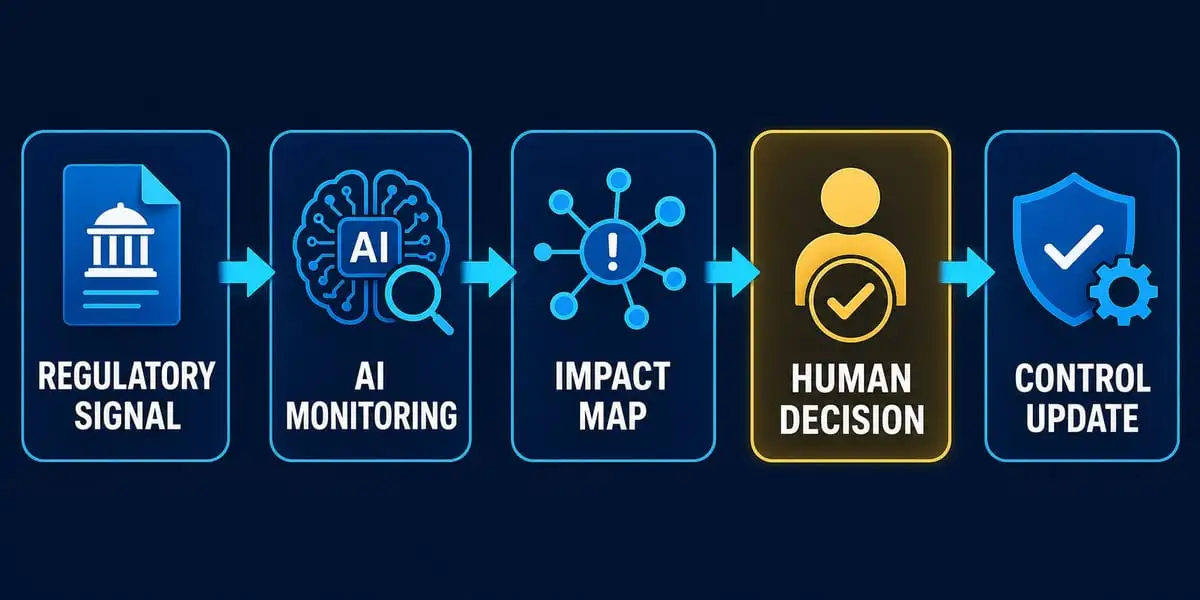
Workflow at a glance
See the orchestration path before exploring the operating detail.
This domain view shows where AI accelerates the work and where accountable human judgment remains in command.
The business problem
Orchestration redesigns the whole operating loop.
Know-your-customer reviews often become document-search exercises across scanned identities, forms, corporate records, and legacy repositories. Compliance expertise is consumed by retrieval rather than risk judgment.
An orchestration layer can find and classify the evidence, compare it with requirements, identify gaps, and prepare the case. Authorized compliance officers determine sufficiency, risk rating, remediation, and any customer impact.
Orchestration corridor
How the work moves from signal to accountable outcome.
Every step has a defined input, intelligence task, action, and handoff. This is what separates an operating system from an isolated prompt.
-
01
Assemble identity
Retrieve customer, beneficial-owner, and corporate evidence from approved systems.
-
02
Classify and extract
Identify document type, issuer, validity, names, dates, and identifiers.
-
03
Compare requirements
Test completeness, consistency, expiry, and jurisdictional rules.
-
04
Prepare review
Present gaps, source links, prior decisions, and recommended follow-up.
-
05
Record disposition
Capture the officer's decision, rationale, remediation, and next review.
Ecosystem command map
The capability lives between systems, not inside one model.
The four quadrants show the assets that must be coordinated. Select any quadrant to emphasize its role in the operating system.
Signals
What enters the system
- Identity and corporate documents
- Customer master data
- Jurisdiction and risk rules
Intelligence
What AI organizes
- Document classification
- Entity resolution
- Requirement and expiry checks
Actions
What the workflow moves
- Prepare case pack
- Request missing evidence
- Prioritize remediation
Human command
Where authority remains
- Compliance officer decides
- Relationship owner communicates
- Quality assurance samples outcomes
Value and control instrument panel
Measure the business result and the integrity of the route.
The bars are not performance claims. They show the measurement sequence: establish the current baseline, agree a pilot threshold, and verify the observed result.
Case preparation time
Minutes to an officer-ready evidence pack
Establish baseline → set pilot threshold → verify outcomeEvidence completeness
Required documents present and current
Establish baseline → set pilot threshold → verify outcomeFalse discrepancy rate
System-raised conflicts dismissed by reviewers
Establish baseline → set pilot threshold → verify outcomeRemediation age
Time outstanding gaps remain unresolved
Establish baseline → set pilot threshold → verify outcome90-day implementation route
Move from reconnaissance to controlled scale.
Select a phase to inspect its executive decision gate.
Phase 1
Recon
Choose a periodic-review segment with known document rules and sufficient volume.
- Executive owner
- Head of Financial Crime Compliance
- Decision gate
- Problem and baseline confirmed
Phase 2
Pilot
Automate retrieval and gap identification while officers complete all judgments.
- Executive owner
- Head of Financial Crime Compliance
- Decision gate
- Value and control thresholds met
Phase 3
Scale
Add entity complexity only after privacy, legal, and model-risk approval.
- Executive owner
- Head of Financial Crime Compliance
- Decision gate
- Operating owner accepts scale
Source and governance discipline
Evidence first. Claims qualified. Accountability designed in.
This operating play is an independent synthesis by Dr. Alejandro Canonero, DBA. It translates a documented implementation into a vendor-neutral business design and applies the War of the Ecosystems perspective. It does not imply endorsement by the source organization.
Executive working session
Apply this pattern to your risk workflow.
A focused diagnosis will map the current work, quantify the opportunity, define human command, and shape the first controlled pilot.