Use case 19 · Operations
Supply-chain traceability and risk
Normalize fragmented supplier and geospatial data, surface risk, and coordinate evidence-backed interventions.
TRACT
Published by Google Cloud
TRACT: Accelerating and enriching analysis with geospatial data and AI
The case describes a platform that structures supply-chain and geospatial data for responsible sourcing, regulatory access, and supplier-risk analysis.
- TRACT reports reaching 80% to 85% supply-chain data completion within weeks and up to 90% to 95% over time.
- The company is applying artificial intelligence to ingestion and validation of heterogeneous geospatial data.
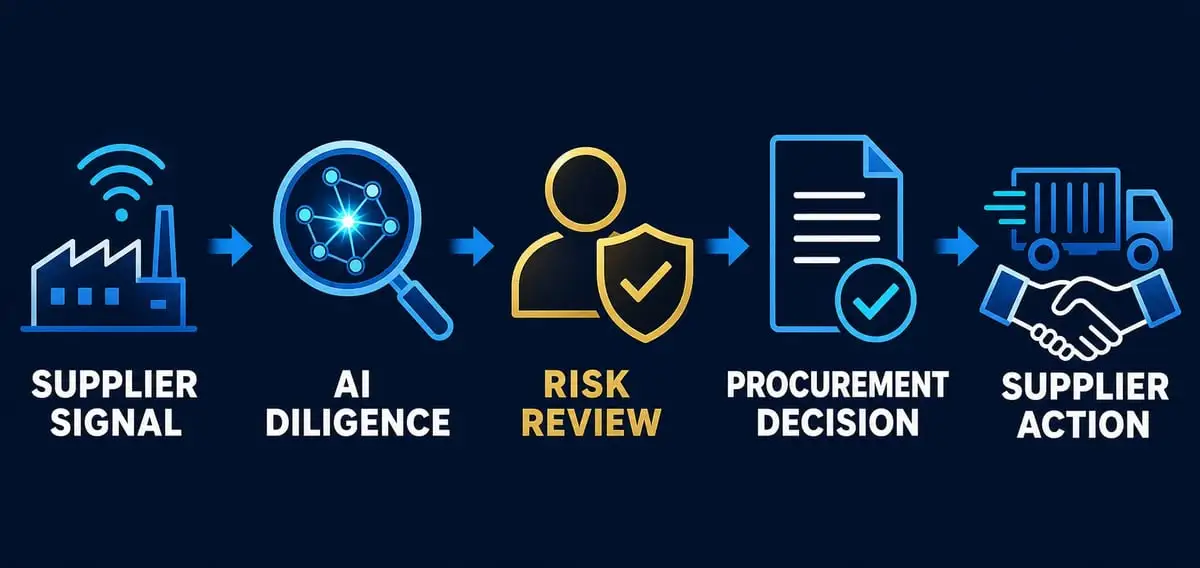
Workflow at a glance
See the orchestration path before exploring the operating detail.
This domain view shows where AI accelerates the work and where accountable human judgment remains in command.
The business problem
Orchestration redesigns the whole operating loop.
Supply-chain risk hides in incomplete supplier records, changing locations, indirect relationships, certifications, regulations, and events. The organization cannot manage what it cannot connect.
AI orchestration can normalize fragmented records, resolve entities and locations, enrich risk signals, and route evidence requests or interventions. Sourcing, compliance, and operations leaders decide supplier actions and remediation.
Orchestration corridor
How the work moves from signal to accountable outcome.
Every step has a defined input, intelligence task, action, and handoff. This is what separates an operating system from an isolated prompt.
-
01
Map the network
Collect supplier, facility, product, geography, ownership, and certification data.
-
02
Normalize identity
Resolve names, locations, tiers, and relationships across inconsistent records.
-
03
Enrich risk
Add regulatory, environmental, labor, disruption, and concentration signals.
-
04
Prioritize intervention
Explain affected products, evidence gaps, severity, and response options.
-
05
Verify improvement
Track supplier evidence, remediation, substitution, and residual exposure.
Ecosystem command map
The capability lives between systems, not inside one model.
The four quadrants show the assets that must be coordinated. Select any quadrant to emphasize its role in the operating system.
Signals
What enters the system
- Supplier and facility records
- Geospatial and certification data
- Regulatory and disruption intelligence
Intelligence
What AI organizes
- Entity and location resolution
- Network mapping
- Risk and evidence-gap analysis
Actions
What the workflow moves
- Request evidence
- Open remediation
- Model substitution or continuity response
Human command
Where authority remains
- Sourcing owns relationship
- Compliance validates obligations
- Operations decides continuity action
Value and control instrument panel
Measure the business result and the integrity of the route.
The bars are not performance claims. They show the measurement sequence: establish the current baseline, agree a pilot threshold, and verify the observed result.
Network coverage
Spend or product volume mapped beyond tier one
Establish baseline → set pilot threshold → verify outcomeData completeness
Required supplier and facility evidence available
Establish baseline → set pilot threshold → verify outcomeRisk-response time
Time from signal to accountable action
Establish baseline → set pilot threshold → verify outcomeRemediation closure
High-priority issues resolved with verified evidence
Establish baseline → set pilot threshold → verify outcome90-day implementation route
Move from reconnaissance to controlled scale.
Select a phase to inspect its executive decision gate.
Phase 1
Recon
Select one product family, geography, or regulatory exposure with a defined supplier set.
- Executive owner
- Chief Supply Chain Officer
- Decision gate
- Problem and baseline confirmed
Phase 2
Pilot
Normalize the network and test evidence-gap alerts before risk scoring.
- Executive owner
- Chief Supply Chain Officer
- Decision gate
- Value and control thresholds met
Phase 3
Scale
Add external signals and intervention workflows after supplier governance review.
- Executive owner
- Chief Supply Chain Officer
- Decision gate
- Operating owner accepts scale
Source and governance discipline
Evidence first. Claims qualified. Accountability designed in.
This operating play is an independent synthesis by Dr. Alejandro Canonero, DBA. It translates a documented implementation into a vendor-neutral business design and applies the War of the Ecosystems perspective. It does not imply endorsement by the source organization.
Executive working session
Apply this pattern to your operations workflow.
A focused diagnosis will map the current work, quantify the opportunity, define human command, and shape the first controlled pilot.