Use case 20 · Growth
Marketing content supply chain
Coordinate brief, creation, review, brand, legal, accessibility, localization, publishing, and performance learning.
Gradial
Published by Amazon Web Services
How Gradial built an agentic AI platform for the end-to-end content supply chain using AWS
The case describes agents coordinating page and email production, updates, campaign quality assurance, search governance, brand compliance, accessibility, and digital journey mapping.
- The published case reports some enterprise customers seeing up to 20-times efficiency gains.
- It also reports 99.9% accuracy for selected content-operations workflows at named customers.
Workflow at a glance
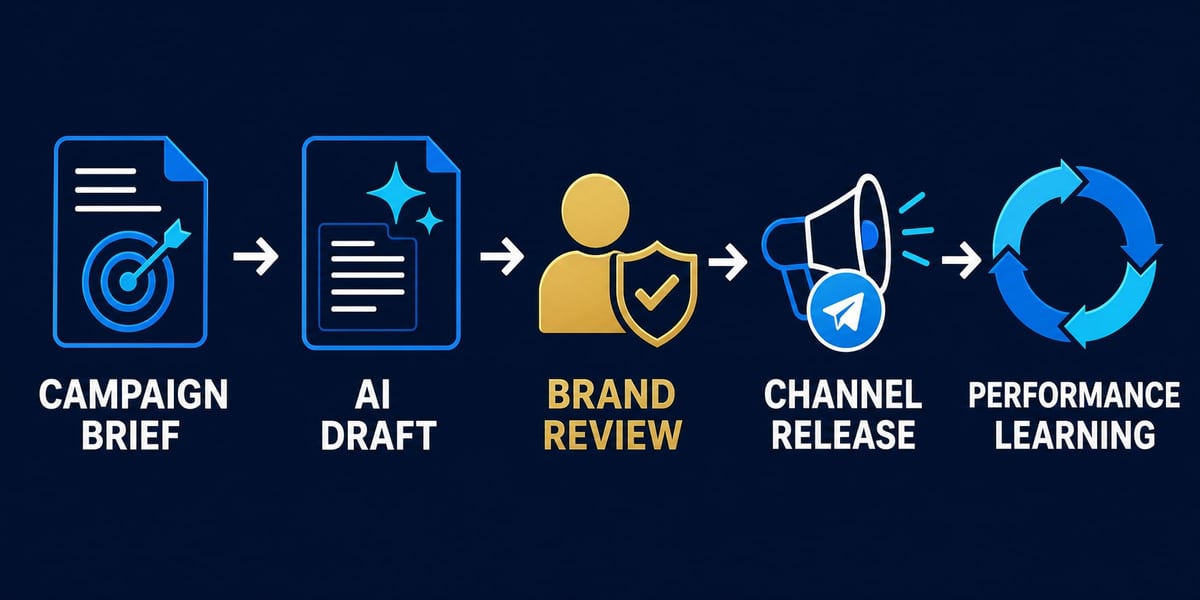
See the orchestration path before exploring the operating detail.
This domain view shows where AI accelerates the work and where accountable human judgment remains in command.
The business problem
Orchestration redesigns the whole operating loop.
Content operations slow down across briefs, source material, creative production, brand review, legal approval, accessibility, localization, page building, quality assurance, and publishing. Generating text or images addresses only one part of the chain.
AI orchestration can coordinate the full movement from approved brief to measured performance. Marketers and creative leaders own the idea, claims, brand, audience judgment, approvals, and final release.
Orchestration corridor
How the work moves from signal to accountable outcome.
Every step has a defined input, intelligence task, action, and handoff. This is what separates an operating system from an isolated prompt.
-
01
Authorize the brief
Define audience, business outcome, proposition, proof, channels, and constraints.
-
02
Assemble source truth
Retrieve approved claims, product facts, brand assets, and prior learning.
-
03
Create and adapt
Produce channel variants, localization, metadata, and accessible alternatives.
-
04
Review and release
Route brand, legal, accessibility, and owner approval before publishing.
-
05
Learn from response
Connect performance and audience signals to the next brief.
Ecosystem command map
The capability lives between systems, not inside one model.
The four quadrants show the assets that must be coordinated. Select any quadrant to emphasize its role in the operating system.
Signals
What enters the system
- Approved brief and source material
- Brand, legal, and accessibility rules
- Channel and performance data
Intelligence
What AI organizes
- Content and asset matching
- Variant generation
- Quality and compliance checks
Actions
What the workflow moves
- Prepare campaign pack
- Route approvals
- Publish through authorized systems
Human command
Where authority remains
- Creative owner directs
- Legal and brand approve
- Channel owner releases and measures
Value and control instrument panel
Measure the business result and the integrity of the route.
The bars are not performance claims. They show the measurement sequence: establish the current baseline, agree a pilot threshold, and verify the observed result.
Cycle time
Elapsed time from approved brief to live content
Establish baseline → set pilot threshold → verify outcomeFirst-pass approval
Assets approved without major rework
Establish baseline → set pilot threshold → verify outcomeReuse and adaptation
Approved components reused across channels and markets
Establish baseline → set pilot threshold → verify outcomeBusiness performance
Qualified engagement, conversion, and contribution by asset
Establish baseline → set pilot threshold → verify outcome90-day implementation route
Move from reconnaissance to controlled scale.
Select a phase to inspect its executive decision gate.
Phase 1
Recon
Map one recurring campaign type across brief, review, production, and publishing.
- Executive owner
- Chief Marketing Officer
- Decision gate
- Problem and baseline confirmed
Phase 2
Pilot
Orchestrate adaptation and quality checks using already-approved source material.
- Executive owner
- Chief Marketing Officer
- Decision gate
- Value and control thresholds met
Phase 3
Scale
Connect publishing and performance only after brand and legal confidence.
- Executive owner
- Chief Marketing Officer
- Decision gate
- Operating owner accepts scale
Source and governance discipline
Evidence first. Claims qualified. Accountability designed in.
This operating play is an independent synthesis by Dr. Alejandro Canonero, DBA. It translates a documented implementation into a vendor-neutral business design and applies the War of the Ecosystems perspective. It does not imply endorsement by the source organization.
Executive working session
Apply this pattern to your growth workflow.
A focused diagnosis will map the current work, quantify the opportunity, define human command, and shape the first controlled pilot.