Use case 13 · Healthcare
Clinical utilization review
Assemble patient-chart evidence and draft structured rationales while clinicians retain every care judgment.
AdventHealth
Published by OpenAI
AdventHealth advances whole-person care with OpenAI
The case describes physician advisers using artificial intelligence to generate structured chart summaries, surface clinical details, and draft initial rationales.
- AdventHealth reports an 80% reduction in time spent on selected administrative tasks.
- The organization measures impact through timestamps in electronic health records rather than self-reported estimates.
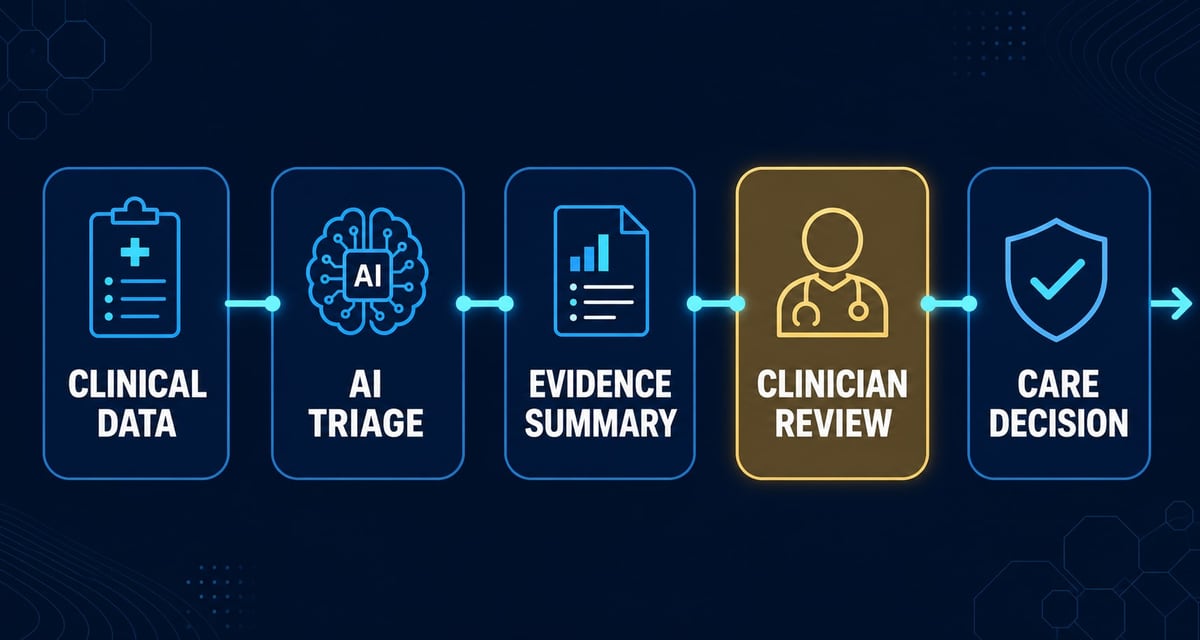
Workflow at a glance
See the orchestration path before exploring the operating detail.
This domain view shows where AI accelerates the work and where accountable human judgment remains in command.
The business problem
Orchestration redesigns the whole operating loop.
Utilization review requires clinicians to find relevant history, diagnoses, treatment, tests, and policy criteria across long patient records. The administrative burden delays decisions and consumes scarce clinical capacity.
AI orchestration can assemble a structured chart summary, surface relevant details, and draft an initial rationale. A licensed clinician validates the evidence, applies medical judgment, and owns the final decision.
Orchestration corridor
How the work moves from signal to accountable outcome.
Every step has a defined input, intelligence task, action, and handoff. This is what separates an operating system from an isolated prompt.
-
01
Open the case
Receive the review request, patient context, question, and applicable criteria.
-
02
Assemble evidence
Retrieve relevant notes, tests, diagnoses, treatments, and chronology.
-
03
Map to criteria
Show supporting and conflicting evidence with source-level references.
-
04
Draft rationale
Prepare a structured first draft with uncertainty and missing information.
-
05
Clinician decides
Validate, edit, sign, communicate, and record the final judgment.
Ecosystem command map
The capability lives between systems, not inside one model.
The four quadrants show the assets that must be coordinated. Select any quadrant to emphasize its role in the operating system.
Signals
What enters the system
- Electronic health record
- Review request and policy
- Clinical guidelines and local pathways
Intelligence
What AI organizes
- Chart summarization
- Chronology and evidence retrieval
- Criteria mapping
Actions
What the workflow moves
- Prepare review brief
- Draft rationale
- Request missing clinical information
Human command
Where authority remains
- Licensed clinician decides
- Medical leadership sets policy
- Quality and privacy teams monitor
Value and control instrument panel
Measure the business result and the integrity of the route.
The bars are not performance claims. They show the measurement sequence: establish the current baseline, agree a pilot threshold, and verify the observed result.
Review turnaround
Time from request to clinician decision
Establish baseline → set pilot threshold → verify outcomeClinician time
Active minutes required per case
Establish baseline → set pilot threshold → verify outcomeEvidence fidelity
Material facts correctly linked to the record
Establish baseline → set pilot threshold → verify outcomeRework and appeal
Cases returned, corrected, or overturned
Establish baseline → set pilot threshold → verify outcome90-day implementation route
Move from reconnaissance to controlled scale.
Select a phase to inspect its executive decision gate.
Phase 1
Recon
Choose one review type with clear criteria and experienced physician advisers.
- Executive owner
- Chief Medical Officer
- Decision gate
- Problem and baseline confirmed
Phase 2
Pilot
Generate chart summaries and rationale drafts without changing the decision path.
- Executive owner
- Chief Medical Officer
- Decision gate
- Value and control thresholds met
Phase 3
Scale
Expand only after clinical safety, privacy, and quality review.
- Executive owner
- Chief Medical Officer
- Decision gate
- Operating owner accepts scale
Source and governance discipline
Evidence first. Claims qualified. Accountability designed in.
This operating play is an independent synthesis by Dr. Alejandro Canonero, DBA. It translates a documented implementation into a vendor-neutral business design and applies the War of the Ecosystems perspective. It does not imply endorsement by the source organization.
Executive working session
Apply this pattern to your healthcare workflow.
A focused diagnosis will map the current work, quantify the opportunity, define human command, and shape the first controlled pilot.