Use case 14 · Healthcare
Clinical trial matching
Compare unstructured patient records with complex trial criteria and prepare clinician-validated eligibility evidence.
Paradigm
Published by OpenAI
Using AI to improve patient access to clinical trials
The case describes large-language-model evaluation of medical records for clinical-trial data extraction and matching against expert-curated data.
- Paradigm reports a 90% reduction in expert-clinician time required for model validation.
- The company reports a 10% increase in blended precision and recall compared with prior specialized models.
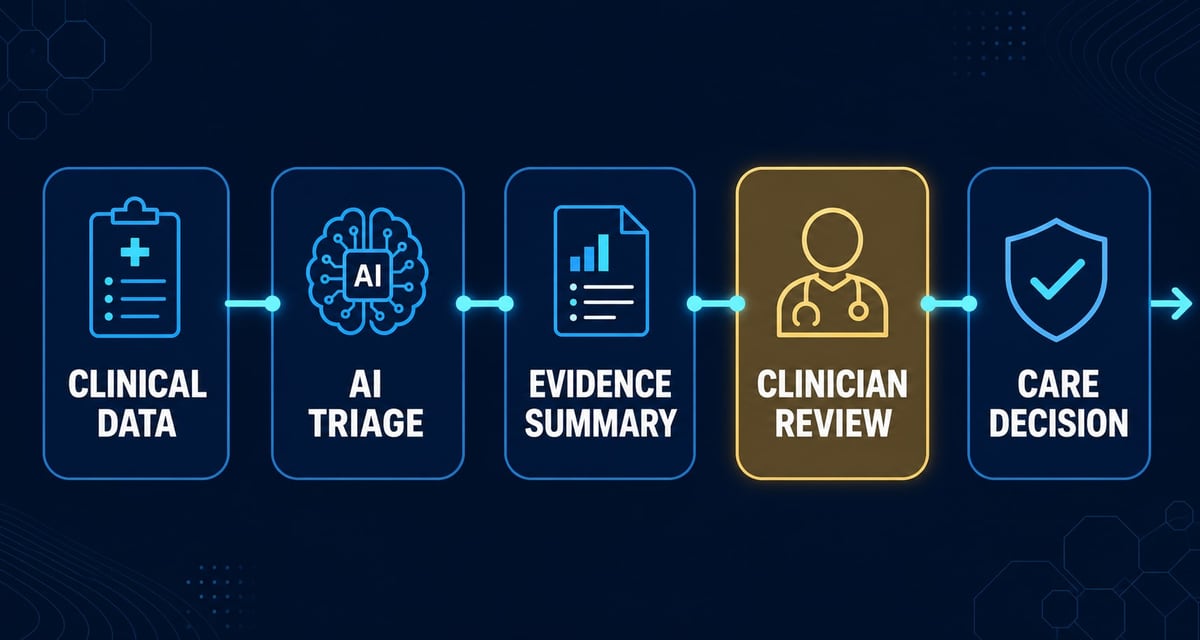
Workflow at a glance
See the orchestration path before exploring the operating detail.
This domain view shows where AI accelerates the work and where accountable human judgment remains in command.
The business problem
Orchestration redesigns the whole operating loop.
Trial matching requires coordinators to interpret complex inclusion and exclusion criteria against fragmented, often unstructured patient records. Manual screening limits scale and can restrict access to patients near research centers.
AI orchestration can extract relevant facts, compare criteria, identify missing evidence, and rank cases for review. Clinical teams confirm eligibility, contact patients, obtain consent, and make every care and enrollment decision.
Orchestration corridor
How the work moves from signal to accountable outcome.
Every step has a defined input, intelligence task, action, and handoff. This is what separates an operating system from an isolated prompt.
-
01
Normalize the protocol
Structure inclusion, exclusion, timing, evidence, and site constraints.
-
02
Read the record
Extract diagnoses, treatments, tests, dates, status, and uncertainty.
-
03
Compare criteria
Mark supported, unsupported, contradictory, and missing evidence.
-
04
Prioritize review
Present likely candidates and questions to the research team.
-
05
Confirm and engage
Clinicians validate eligibility and manage consent and enrollment.
Ecosystem command map
The capability lives between systems, not inside one model.
The four quadrants show the assets that must be coordinated. Select any quadrant to emphasize its role in the operating system.
Signals
What enters the system
- Trial protocol and amendments
- Patient record and test results
- Site capacity and geography
Intelligence
What AI organizes
- Criteria structuring
- Clinical fact extraction
- Eligibility evidence matching
Actions
What the workflow moves
- Prepare candidate list
- Identify missing tests
- Draft coordinator brief
Human command
Where authority remains
- Research clinician confirms
- Site manages consent
- Governance monitors equity and safety
Value and control instrument panel
Measure the business result and the integrity of the route.
The bars are not performance claims. They show the measurement sequence: establish the current baseline, agree a pilot threshold, and verify the observed result.
Screening capacity
Records assessed per coordinator hour
Establish baseline → set pilot threshold → verify outcomeCandidate precision
Flagged patients confirmed potentially eligible
Establish baseline → set pilot threshold → verify outcomeEvidence completeness
Criteria supported by traceable record data
Establish baseline → set pilot threshold → verify outcomeAccess reach
Eligible candidates identified beyond prior referral patterns
Establish baseline → set pilot threshold → verify outcome90-day implementation route
Move from reconnaissance to controlled scale.
Select a phase to inspect its executive decision gate.
Phase 1
Recon
Choose one active protocol with clear criteria and an expert-reviewed benchmark set.
- Executive owner
- Head of Clinical Research
- Decision gate
- Problem and baseline confirmed
Phase 2
Pilot
Run retrospective comparison before prospective coordinator support.
- Executive owner
- Head of Clinical Research
- Decision gate
- Value and control thresholds met
Phase 3
Scale
Add sites or protocols only after protocol-specific validation.
- Executive owner
- Head of Clinical Research
- Decision gate
- Operating owner accepts scale
Source and governance discipline
Evidence first. Claims qualified. Accountability designed in.
This operating play is an independent synthesis by Dr. Alejandro Canonero, DBA. It translates a documented implementation into a vendor-neutral business design and applies the War of the Ecosystems perspective. It does not imply endorsement by the source organization.
Executive working session
Apply this pattern to your healthcare workflow.
A focused diagnosis will map the current work, quantify the opportunity, define human command, and shape the first controlled pilot.