Use case 15 · Technology
Cybersecurity incident triage
Correlate alerts, enrich threat context, prepare incident timelines, and guide analysts through response playbooks.
St. Luke's University Health Network
Published by Microsoft
St. Luke's saves nearly 200 hours monthly with AI-powered Security Copilot agents
The case describes an artificial-intelligence layer connecting alerts, access controls, vulnerabilities, investigation, and incident reporting.
- St. Luke's reports nearly 200 hours saved each month in phishing-alert triage.
- The organization reports incident reports reduced from hours of work to minutes.
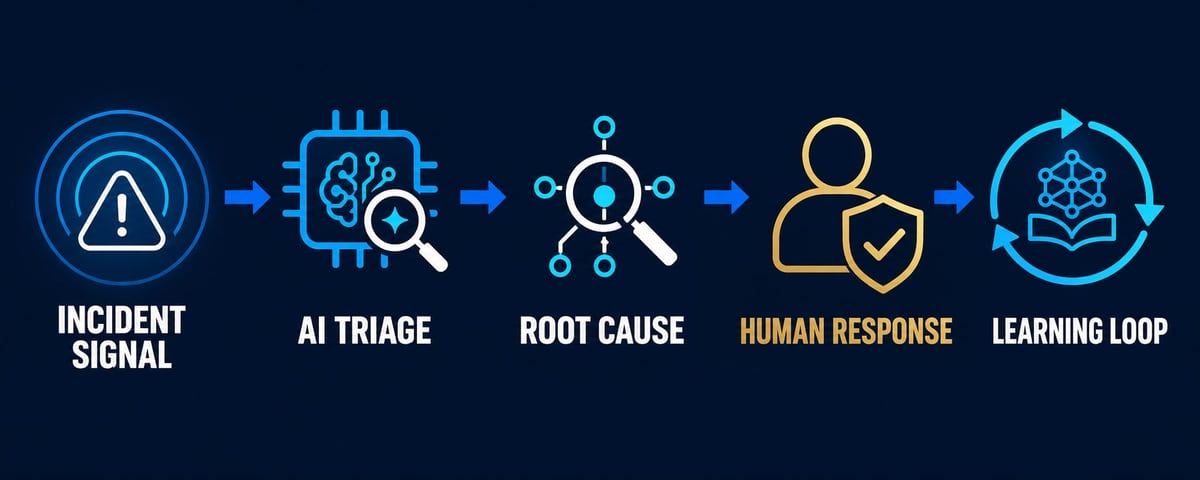
Workflow at a glance
See the orchestration path before exploring the operating detail.
This domain view shows where AI accelerates the work and where accountable human judgment remains in command.
The business problem
Orchestration redesigns the whole operating loop.
Security teams face fragmented alerts, identities, endpoints, threat intelligence, logs, and response tools. Analysts lose time moving between systems and reconstructing the incident before they can act.
AI orchestration can correlate signals, summarize the attack path, propose investigative steps, and draft an incident report. Analysts validate the evidence and authorize containment, eradication, recovery, and communication.
Orchestration corridor
How the work moves from signal to accountable outcome.
Every step has a defined input, intelligence task, action, and handoff. This is what separates an operating system from an isolated prompt.
-
01
Collect signals
Unify alert, identity, endpoint, cloud, email, and vulnerability context.
-
02
Correlate
Group related events and construct a probable attack timeline.
-
03
Investigate
Enrich with threat intelligence and recommend evidence-led queries.
-
04
Contain with authority
Present actions, blast radius, reversibility, and required approval.
-
05
Learn and harden
Draft the report, update detections, and track remediation.
Ecosystem command map
The capability lives between systems, not inside one model.
The four quadrants show the assets that must be coordinated. Select any quadrant to emphasize its role in the operating system.
Signals
What enters the system
- Security alerts and telemetry
- Identity and asset context
- Threat intelligence and vulnerabilities
Intelligence
What AI organizes
- Alert correlation
- Attack-path reconstruction
- Response recommendation
Actions
What the workflow moves
- Prioritize incident
- Run approved query
- Prepare containment and report
Human command
Where authority remains
- Analyst validates
- Incident commander authorizes disruption
- Leadership owns material communication
Value and control instrument panel
Measure the business result and the integrity of the route.
The bars are not performance claims. They show the measurement sequence: establish the current baseline, agree a pilot threshold, and verify the observed result.
Time to triage
Minutes from alert to validated priority
Establish baseline → set pilot threshold → verify outcomeTime to contain
Elapsed time to approved containment
Establish baseline → set pilot threshold → verify outcomeAnalyst load
Alerts and incidents handled per shift
Establish baseline → set pilot threshold → verify outcomeInvestigation quality
Reopened incidents and missed related activity
Establish baseline → set pilot threshold → verify outcome90-day implementation route
Move from reconnaissance to controlled scale.
Select a phase to inspect its executive decision gate.
Phase 1
Recon
Start with phishing or one high-volume alert family and a mature response playbook.
- Executive owner
- Chief Information Security Officer
- Decision gate
- Problem and baseline confirmed
Phase 2
Pilot
Use summaries and report generation while analysts perform all actions.
- Executive owner
- Chief Information Security Officer
- Decision gate
- Value and control thresholds met
Phase 3
Scale
Add bounded response tools only after simulation and approval testing.
- Executive owner
- Chief Information Security Officer
- Decision gate
- Operating owner accepts scale
Source and governance discipline
Evidence first. Claims qualified. Accountability designed in.
This operating play is an independent synthesis by Dr. Alejandro Canonero, DBA. It translates a documented implementation into a vendor-neutral business design and applies the War of the Ecosystems perspective. It does not imply endorsement by the source organization.
Executive working session
Apply this pattern to your technology workflow.
A focused diagnosis will map the current work, quantify the opportunity, define human command, and shape the first controlled pilot.