Use case 16 · Technology
Information technology service desk resolution
Unify incidents, knowledge, observability, change history, and safe playbooks to restore service faster.
mobilezone
Published by Microsoft
mobilezone transforms its internal service desk with an AI agent
The case describes an internal service-desk agent that gathers context conversationally, distinguishes incidents from service requests, creates structured tickets, and resolves simpler issues.
- mobilezone reports a 50% reduction in information technology resolution time.
- The agent now handles first-line internal service requests across the organization.
Workflow at a glance
See the orchestration path before exploring the operating detail.
This domain view shows where AI accelerates the work and where accountable human judgment remains in command.
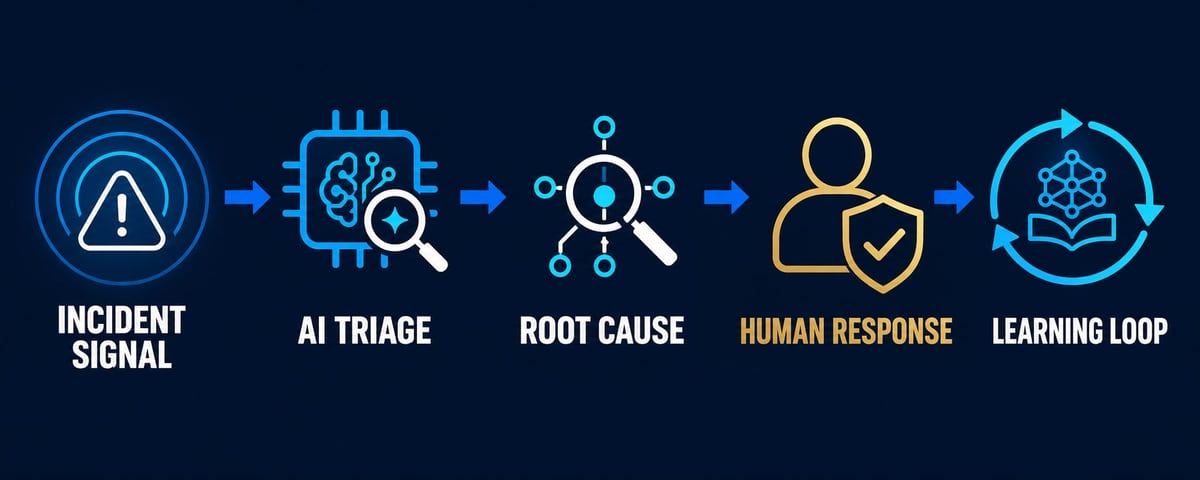
The business problem
Orchestration redesigns the whole operating loop.
Service desks are slowed by tab switching, manual classification, weak knowledge, incomplete incident records, and unclear escalation. A ticket is usually the visible symptom of a wider system condition.
AI orchestration can understand the request, retrieve relevant knowledge, correlate telemetry, launch approved diagnostics, and summarize the handoff. Engineers keep authority over changes, privileged access, and high-impact restoration.
Orchestration corridor
How the work moves from signal to accountable outcome.
Every step has a defined input, intelligence task, action, and handoff. This is what separates an operating system from an isolated prompt.
-
01
Understand demand
Classify requester, service, urgency, business impact, and symptom.
-
02
Assemble service context
Retrieve knowledge, asset, change, incident, and observability data.
-
03
Diagnose
Compare known issues and run approved read-only checks.
-
04
Resolve or escalate
Execute a reversible playbook or transfer a complete technical brief.
-
05
Strengthen knowledge
Capture the verified fix, root-cause signal, and article improvement.
Ecosystem command map
The capability lives between systems, not inside one model.
The four quadrants show the assets that must be coordinated. Select any quadrant to emphasize its role in the operating system.
Signals
What enters the system
- Ticket and employee context
- Assets, changes, and dependencies
- Logs, metrics, traces, and knowledge
Intelligence
What AI organizes
- Classification and routing
- Known-error matching
- Probable cause and next action
Actions
What the workflow moves
- Answer or guide
- Run approved remediation
- Escalate with diagnostics
Human command
Where authority remains
- Service owner sets policy
- Engineer approves risky change
- Problem management owns systemic fix
Value and control instrument panel
Measure the business result and the integrity of the route.
The bars are not performance claims. They show the measurement sequence: establish the current baseline, agree a pilot threshold, and verify the observed result.
Mean time to resolution
Elapsed time to verified service restoration
Establish baseline → set pilot threshold → verify outcomeFirst-line resolution
Cases resolved without higher-tier escalation
Establish baseline → set pilot threshold → verify outcomeHandoff completeness
Escalations accepted without repeated discovery
Establish baseline → set pilot threshold → verify outcomeRepeat incident rate
Recurrence after apparent resolution
Establish baseline → set pilot threshold → verify outcome90-day implementation route
Move from reconnaissance to controlled scale.
Select a phase to inspect its executive decision gate.
Phase 1
Recon
Choose five high-volume request types with stable knowledge and low-risk actions.
- Executive owner
- Chief Information Officer
- Decision gate
- Problem and baseline confirmed
Phase 2
Pilot
Deploy retrieval, triage, and handoff summaries with human execution.
- Executive owner
- Chief Information Officer
- Decision gate
- Value and control thresholds met
Phase 3
Scale
Add reversible remediation one playbook at a time.
- Executive owner
- Chief Information Officer
- Decision gate
- Operating owner accepts scale
Source and governance discipline
Evidence first. Claims qualified. Accountability designed in.
This operating play is an independent synthesis by Dr. Alejandro Canonero, DBA. It translates a documented implementation into a vendor-neutral business design and applies the War of the Ecosystems perspective. It does not imply endorsement by the source organization.
Executive working session
Apply this pattern to your technology workflow.
A focused diagnosis will map the current work, quantify the opportunity, define human command, and shape the first controlled pilot.