Use case 17 · Operations
Manufacturing quality inspection
Coordinate visual inspection, process context, defect review, corrective action, and model feedback across production sites.
LG Electronics
Published by Google Cloud
LG Electronics manufacturing AI quality inspection platform
The case describes a standardized artificial-intelligence quality-inspection platform deployed across manufacturing environments while keeping production data local.
- LG Electronics reports quality-model development time shortened by more than 50%.
- The company reports false defect judgments reduced by 95% on applied production lines.
Workflow at a glance
See the orchestration path before exploring the operating detail.
This domain view shows where AI accelerates the work and where accountable human judgment remains in command.
The business problem
Orchestration redesigns the whole operating loop.
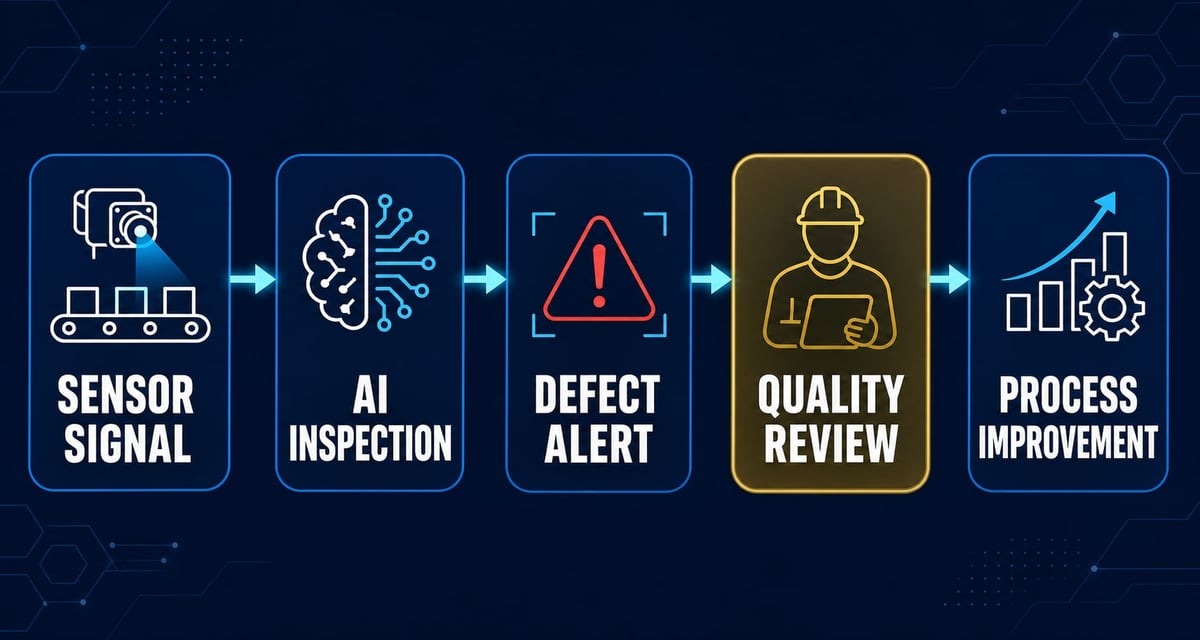
Quality inspection is more than image classification. The operating loop links product, machine, process conditions, defect taxonomy, operator review, rework, root cause, and corrective action across sites.
AI orchestration can inspect, retrieve production context, prioritize uncertain defects, and update the quality record. Authorized operators and quality engineers decide disposition, containment, process change, and release.
Orchestration corridor
How the work moves from signal to accountable outcome.
Every step has a defined input, intelligence task, action, and handoff. This is what separates an operating system from an isolated prompt.
-
01
Sense
Capture product image, process condition, machine, lot, and supplier context.
-
02
Inspect
Classify likely defect and quantify model confidence and novelty.
-
03
Route uncertainty
Send ambiguous or high-consequence items to the right quality expert.
-
04
Control production
Record disposition and trigger approved containment or rework.
-
05
Improve the system
Link confirmed outcomes to root cause and model retraining.
Ecosystem command map
The capability lives between systems, not inside one model.
The four quadrants show the assets that must be coordinated. Select any quadrant to emphasize its role in the operating system.
Signals
What enters the system
- Images and sensor data
- Product, lot, and process context
- Defect library and quality standards
Intelligence
What AI organizes
- Visual inspection
- Confidence and novelty detection
- Root-cause correlation
Actions
What the workflow moves
- Pass, hold, or route
- Open nonconformance
- Trigger approved containment
Human command
Where authority remains
- Operator confirms edge cases
- Quality authority decides disposition
- Engineering changes process
Value and control instrument panel
Measure the business result and the integrity of the route.
The bars are not performance claims. They show the measurement sequence: establish the current baseline, agree a pilot threshold, and verify the observed result.
False reject rate
Good units incorrectly held as defective
Establish baseline → set pilot threshold → verify outcomeEscape rate
Defects found after the inspection point
Establish baseline → set pilot threshold → verify outcomeReview load
Items requiring human inspection
Establish baseline → set pilot threshold → verify outcomeContainment speed
Time from signal to controlled lot or process
Establish baseline → set pilot threshold → verify outcome90-day implementation route
Move from reconnaissance to controlled scale.
Select a phase to inspect its executive decision gate.
Phase 1
Recon
Choose one visible defect family with reliable labels and clear disposition rules.
- Executive owner
- Chief Operations Officer
- Decision gate
- Problem and baseline confirmed
Phase 2
Pilot
Run shadow inspection and compare with current quality outcomes.
- Executive owner
- Chief Operations Officer
- Decision gate
- Value and control thresholds met
Phase 3
Scale
Connect line control only after fail-safe and drift testing.
- Executive owner
- Chief Operations Officer
- Decision gate
- Operating owner accepts scale
Source and governance discipline
Evidence first. Claims qualified. Accountability designed in.
This operating play is an independent synthesis by Dr. Alejandro Canonero, DBA. It translates a documented implementation into a vendor-neutral business design and applies the War of the Ecosystems perspective. It does not imply endorsement by the source organization.
Executive working session
Apply this pattern to your operations workflow.
A focused diagnosis will map the current work, quantify the opportunity, define human command, and shape the first controlled pilot.