Use case 18 · Operations
Field service and work-order reporting
Give technicians the right instructions, capture evidence, and produce consistent customer reports from the completed work.
Siemens Smart Infrastructure
Published by Microsoft
Siemens elevates field service operations with Microsoft Dynamics 365
The case describes generative artificial intelligence helping more than 10,000 field technicians create clearer, more consistent customer work-order reports.
- The business generates more than 1.4 million work-order reports each year.
- Siemens reports early improvement in report consistency and expects streamlined technician workflows.
Workflow at a glance
See the orchestration path before exploring the operating detail.
This domain view shows where AI accelerates the work and where accountable human judgment remains in command.
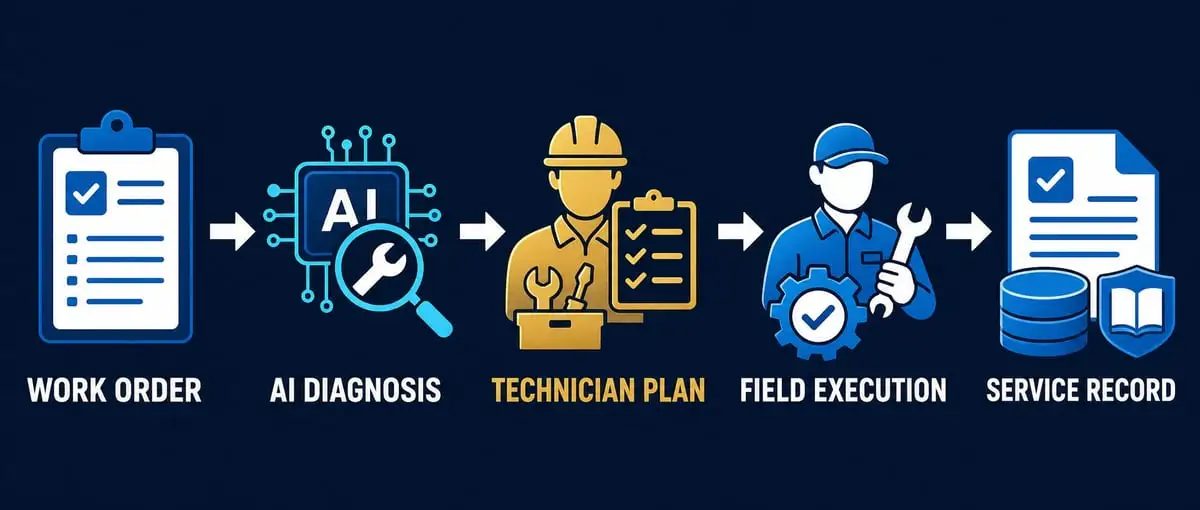
The business problem
Orchestration redesigns the whole operating loop.
Field technicians operate at the edge of the enterprise with equipment history, manuals, schedules, parts, safety procedures, customer expectations, and reporting obligations. Searching and writing can consume the time meant for service.
AI orchestration can assemble job context, retrieve instructions, guide evidence capture, and draft the work report. Technicians own diagnosis, safe execution, completion, and the accuracy of the customer record.
Orchestration corridor
How the work moves from signal to accountable outcome.
Every step has a defined input, intelligence task, action, and handoff. This is what separates an operating system from an isolated prompt.
-
01
Prepare the visit
Assemble asset history, issue, entitlement, schedule, parts, and safety context.
-
02
Guide the diagnosis
Retrieve relevant procedures and ask for required observations.
-
03
Capture the work
Record actions, parts, readings, images, exceptions, and customer discussion.
-
04
Draft the report
Turn evidence into a clear, standardized customer explanation.
-
05
Close the loop
Technician approves, customer receives, and asset history is updated.
Ecosystem command map
The capability lives between systems, not inside one model.
The four quadrants show the assets that must be coordinated. Select any quadrant to emphasize its role in the operating system.
Signals
What enters the system
- Work order and asset history
- Manuals, bulletins, and safety rules
- Technician notes, readings, and images
Intelligence
What AI organizes
- Contextual retrieval
- Diagnostic guidance
- Report generation
Actions
What the workflow moves
- Prepare job brief
- Suggest procedure
- Draft customer report
Human command
Where authority remains
- Technician controls work
- Safety rules override automation
- Service manager reviews exceptions
Value and control instrument panel
Measure the business result and the integrity of the route.
The bars are not performance claims. They show the measurement sequence: establish the current baseline, agree a pilot threshold, and verify the observed result.
Technician utilization
Share of paid time spent on productive service
Establish baseline → set pilot threshold → verify outcomeFirst-time fix
Jobs completed without repeat visit
Establish baseline → set pilot threshold → verify outcomeReport cycle time
Time from work completion to customer-ready report
Establish baseline → set pilot threshold → verify outcomeReport quality
Completeness, consistency, and customer clarification rate
Establish baseline → set pilot threshold → verify outcome90-day implementation route
Move from reconnaissance to controlled scale.
Select a phase to inspect its executive decision gate.
Phase 1
Recon
Choose one service line with stable manuals and high reporting volume.
- Executive owner
- Head of Field Service
- Decision gate
- Problem and baseline confirmed
Phase 2
Pilot
Draft reports from completed evidence before adding diagnostic guidance.
- Executive owner
- Head of Field Service
- Decision gate
- Value and control thresholds met
Phase 3
Scale
Add retrieval and scheduling integration after technician acceptance.
- Executive owner
- Head of Field Service
- Decision gate
- Operating owner accepts scale
Source and governance discipline
Evidence first. Claims qualified. Accountability designed in.
This operating play is an independent synthesis by Dr. Alejandro Canonero, DBA. It translates a documented implementation into a vendor-neutral business design and applies the War of the Ecosystems perspective. It does not imply endorsement by the source organization.
Executive working session
Apply this pattern to your operations workflow.
A focused diagnosis will map the current work, quantify the opportunity, define human command, and shape the first controlled pilot.