Use case 01 · Customer
Customer service resolution
Resolve routine requests across knowledge, account systems, and escalation queues while preserving a clean human handoff.
Decagon
Published by OpenAI
Decagon and OpenAI deliver high-performance, fully automated customer support at scale
The published case describes tailored support workflows that combine model reasoning, company knowledge, evaluation, and escalation across millions of conversations.
- One large customer reportedly handled 91% of global support without human involvement.
- New customer infrastructure can reportedly be operational in days.
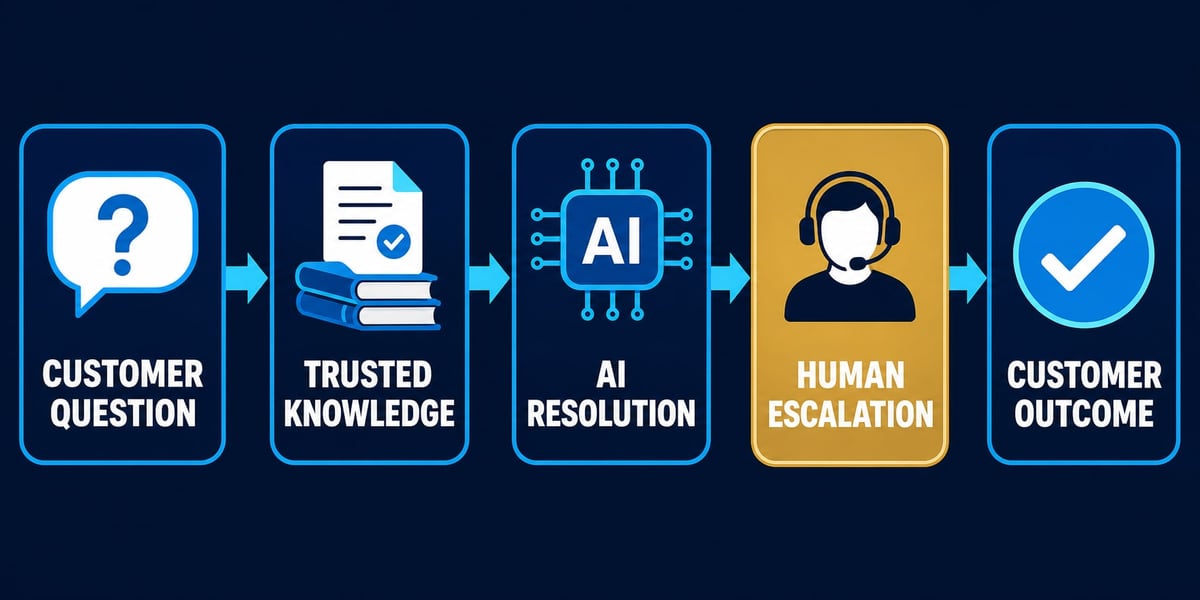
Workflow at a glance
See the orchestration path before exploring the operating detail.
This domain view shows where AI accelerates the work and where accountable human judgment remains in command.
The business problem
Orchestration redesigns the whole operating loop.
Customer service rarely fails because an answer does not exist. It fails because the answer, customer context, policy, and permission to act sit in different systems. A useful orchestration layer assembles that operating context before it responds.
The design objective is not maximum automation. It is dependable resolution: answer routine questions, complete permitted actions, recognize uncertainty, and transfer the full case history when human judgment is required.
War of the Ecosystems proof point
The Command Post Principle: Why AI Service Resolution Is an Ecosystem Problem
Read the executive interpretation connecting this operating design to the Combat Information Center and the central thesis of War of the Ecosystems.
Read the strategic article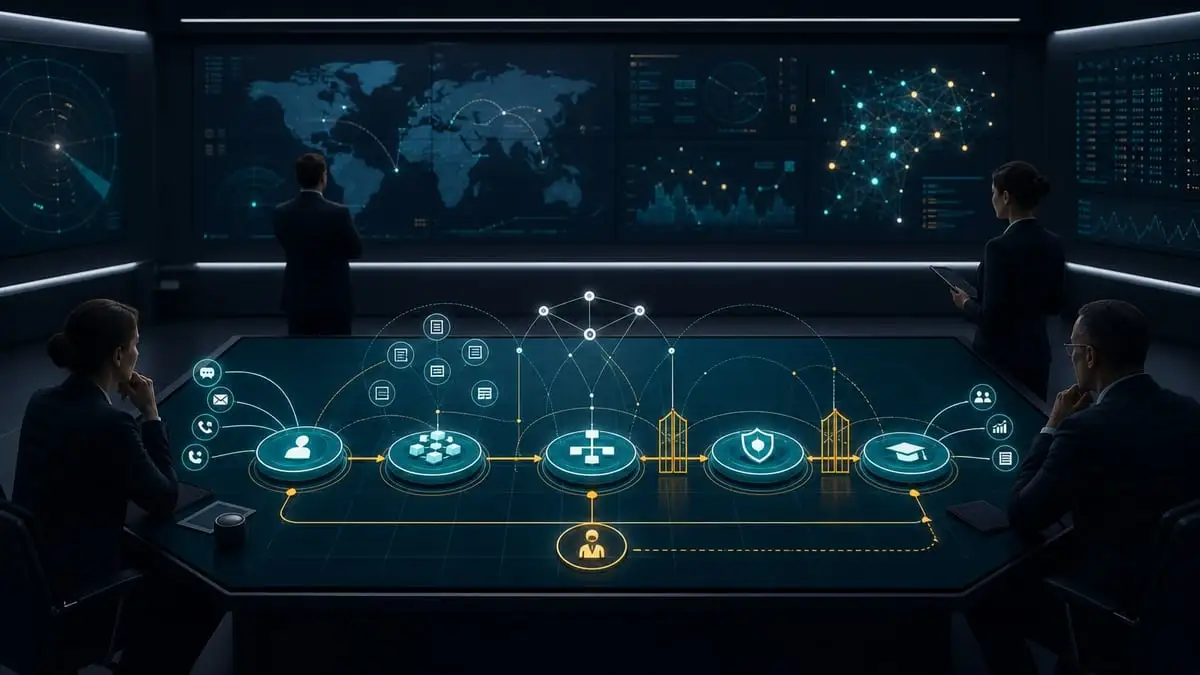
Orchestration corridor
How the work moves from signal to accountable outcome.
Every step has a defined input, intelligence task, action, and handoff. This is what separates an operating system from an isolated prompt.
-
01
Detect intent
Classify the request, language, customer, urgency, and emotional signal.
-
02
Assemble context
Retrieve approved knowledge, account history, entitlements, and relevant policy.
-
03
Plan resolution
Choose an answer, permitted action, clarification, or escalation path.
-
04
Execute safely
Respond or complete a bounded action with identity and policy checks.
-
05
Learn from outcome
Capture resolution, correction, escalation reason, and customer response.
Ecosystem command map
The capability lives between systems, not inside one model.
The four quadrants show the assets that must be coordinated. Select any quadrant to emphasize its role in the operating system.
Signals
What enters the system
- Chat, email, voice transcript
- Account and order history
- Sentiment and urgency
Intelligence
What AI organizes
- Intent routing
- Knowledge retrieval
- Policy and entitlement checks
Actions
What the workflow moves
- Answer
- Update or refund within limits
- Route with a complete summary
Human command
Where authority remains
- Service owner sets policy
- Agent approves exceptions
- Quality team reviews failure patterns
Value and control instrument panel
Measure the business result and the integrity of the route.
The bars are not performance claims. They show the measurement sequence: establish the current baseline, agree a pilot threshold, and verify the observed result.
Resolution time
Median time from first contact to verified resolution
Establish baseline → set pilot threshold → verify outcomeFirst-contact resolution
Share resolved without repeat contact
Establish baseline → set pilot threshold → verify outcomeEscalation quality
Share of transfers accepted without rework
Establish baseline → set pilot threshold → verify outcomeCustomer trust
Satisfaction and complaint rate by resolution path
Establish baseline → set pilot threshold → verify outcome90-day implementation route
Move from reconnaissance to controlled scale.
Select a phase to inspect its executive decision gate.
Phase 1
Recon
Map the top 20 intents, source systems, policy boundaries, and current failure reasons.
- Executive owner
- Chief Customer Officer
- Decision gate
- Problem and baseline confirmed
Phase 2
Pilot
Automate three high-volume, low-consequence intents with full logging and human fallback.
- Executive owner
- Chief Customer Officer
- Decision gate
- Value and control thresholds met
Phase 3
Scale
Expand only when resolution quality, escalation quality, and customer trust hold.
- Executive owner
- Chief Customer Officer
- Decision gate
- Operating owner accepts scale
Source and governance discipline
Evidence first. Claims qualified. Accountability designed in.
This operating play is an independent synthesis by Dr. Alejandro Canonero, DBA. It translates a documented implementation into a vendor-neutral business design and applies the War of the Ecosystems perspective. It does not imply endorsement by the source organization.
Executive working session
Apply this pattern to your customer workflow.
A focused diagnosis will map the current work, quantify the opportunity, define human command, and shape the first controlled pilot.