Use case 08 · Legal
Contract review and obligation management
Compare clauses, identify deviations, prepare negotiation issues, and track obligations with lawyer-controlled conclusions.
Harvey
Published by OpenAI
Customizing models for legal professionals
The case describes legal artificial intelligence supporting complex reasoning tasks including drafting, litigation questions, and identifying discrepancies across hundreds of contracts.
- The published work demonstrates multi-document discrepancy analysis at professional-services scale.
- Harvey uses domain-specific evaluation and customization for legal workflows.
Workflow at a glance
See the orchestration path before exploring the operating detail.
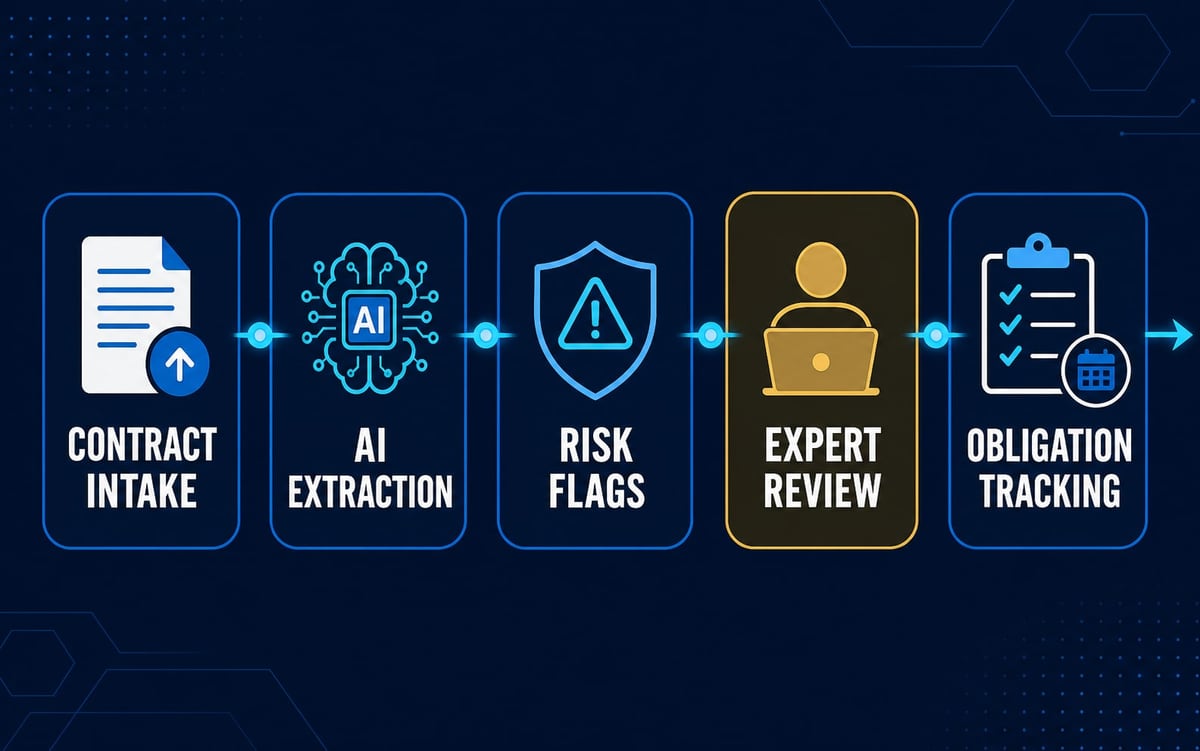
This domain view shows where AI accelerates the work and where accountable human judgment remains in command.
The business problem
Orchestration redesigns the whole operating loop.
Contract work spans intake, document classification, clause comparison, precedent search, issue identification, negotiation, approval, signature, and obligation tracking. A single drafting tool does not solve that system.
AI orchestration can create the comparison and issue map, retrieve approved language, and maintain a post-signature obligation record. Lawyers decide interpretation, risk acceptance, negotiation position, and advice.
Orchestration corridor
How the work moves from signal to accountable outcome.
Every step has a defined input, intelligence task, action, and handoff. This is what separates an operating system from an isolated prompt.
-
01
Intake and classify
Identify agreement type, parties, jurisdiction, status, and related documents.
-
02
Compare
Map clauses against policy, playbook, precedent, and transaction requirements.
-
03
Build issue list
Explain deviations, dependencies, ambiguity, and missing protections.
-
04
Negotiate and approve
Route issues to the lawyer and authorized commercial owner.
-
05
Operationalize
Register obligations, dates, notices, renewals, and accountable owners.
Ecosystem command map
The capability lives between systems, not inside one model.
The four quadrants show the assets that must be coordinated. Select any quadrant to emphasize its role in the operating system.
Signals
What enters the system
- Contract and amendments
- Clause playbook and precedents
- Commercial and risk requirements
Intelligence
What AI organizes
- Clause extraction
- Deviation comparison
- Obligation and dependency mapping
Actions
What the workflow moves
- Draft issue list
- Suggest approved language
- Create obligation register
Human command
Where authority remains
- Lawyer interprets and advises
- Business owner accepts economics
- Authority matrix governs signature
Value and control instrument panel
Measure the business result and the integrity of the route.
The bars are not performance claims. They show the measurement sequence: establish the current baseline, agree a pilot threshold, and verify the observed result.
Review cycle time
Elapsed time from intake to approved position
Establish baseline → set pilot threshold → verify outcomeIssue recall
Material deviations found before signature
Establish baseline → set pilot threshold → verify outcomeNegotiation rework
Repeated rounds caused by unclear positions
Establish baseline → set pilot threshold → verify outcomeObligation performance
Commitments completed before contractual deadlines
Establish baseline → set pilot threshold → verify outcome90-day implementation route
Move from reconnaissance to controlled scale.
Select a phase to inspect its executive decision gate.
Phase 1
Recon
Select one agreement family with a mature playbook and repeatable deviations.
- Executive owner
- General Counsel
- Decision gate
- Problem and baseline confirmed
Phase 2
Pilot
Generate clause maps and issue lists for lawyer comparison.
- Executive owner
- General Counsel
- Decision gate
- Value and control thresholds met
Phase 3
Scale
Connect obligation tracking after legal accuracy and access controls pass review.
- Executive owner
- General Counsel
- Decision gate
- Operating owner accepts scale
Source and governance discipline
Evidence first. Claims qualified. Accountability designed in.
This operating play is an independent synthesis by Dr. Alejandro Canonero, DBA. It translates a documented implementation into a vendor-neutral business design and applies the War of the Ecosystems perspective. It does not imply endorsement by the source organization.
Executive working session
Apply this pattern to your legal workflow.
A focused diagnosis will map the current work, quantify the opportunity, define human command, and shape the first controlled pilot.