Use case 09 · Operations
Procurement and supplier diligence
Coordinate requirements, market intelligence, supplier evidence, evaluation, and compliant contracting.
United States Army procurement community and Koniag Government Services
Published by Amazon Web Services
Koniag Government Services and AWS transform U.S. Army procurement through intelligent automation
The case describes automation and generative artificial intelligence supporting responsibility determinations and contracting-document generation.
- The published case reports 687,000 labor hours saved annually across delivered automation tools.
- It also reports $37 million in annual cost avoidance and some tasks reduced from days to minutes.
Workflow at a glance
See the orchestration path before exploring the operating detail.
This domain view shows where AI accelerates the work and where accountable human judgment remains in command.
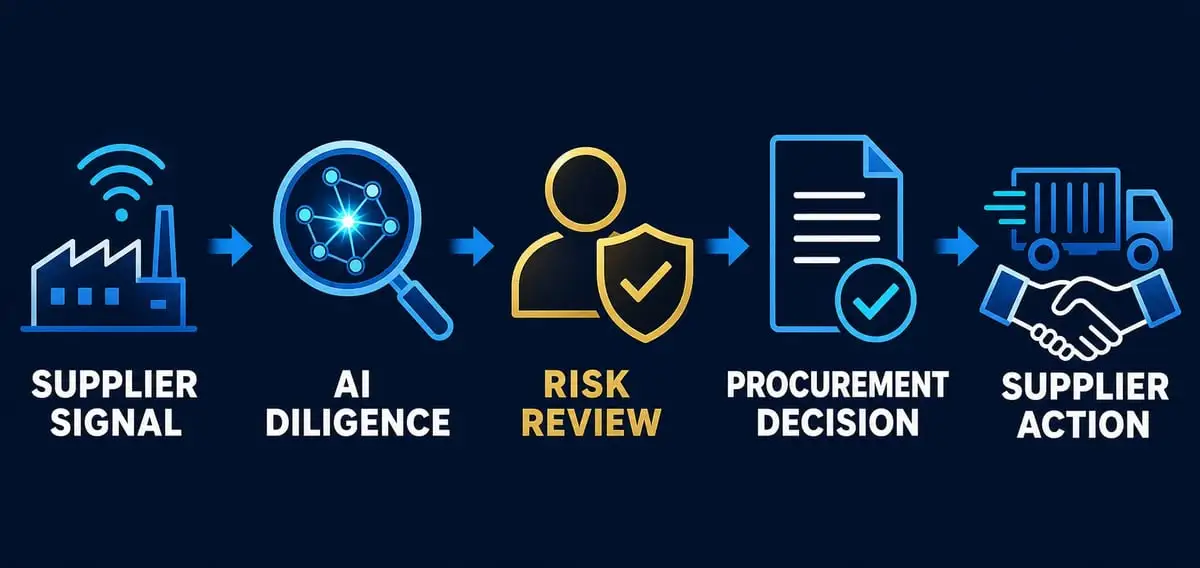
The business problem
Orchestration redesigns the whole operating loop.
Procurement is a multi-party operating system. Requirements, funding, supplier evidence, market research, competition rules, evaluation, approvals, and contract documents must arrive in the right sequence.
AI orchestration can prepare research, classify submissions, draft standard documents, and expose missing evidence. Procurement officials retain source selection, fairness, commercial judgment, and approval.
Orchestration corridor
How the work moves from signal to accountable outcome.
Every step has a defined input, intelligence task, action, and handoff. This is what separates an operating system from an isolated prompt.
-
01
Frame demand
Convert the business need into scope, outcomes, constraints, and evaluation criteria.
-
02
Scan the market
Assemble supplier, pricing, capability, risk, and lifecycle intelligence.
-
03
Prepare competition
Draft approved documents and validate completeness and consistency.
-
04
Evaluate evidence
Structure supplier responses and surface gaps without making the award.
-
05
Contract and monitor
Record obligations, performance measures, risks, and renewal decisions.
Ecosystem command map
The capability lives between systems, not inside one model.
The four quadrants show the assets that must be coordinated. Select any quadrant to emphasize its role in the operating system.
Signals
What enters the system
- Business requirement and budget
- Supplier evidence and market data
- Policy, contract, and risk rules
Intelligence
What AI organizes
- Market synthesis
- Document generation
- Evaluation evidence mapping
Actions
What the workflow moves
- Prepare solicitation pack
- Request clarification
- Build decision record
Human command
Where authority remains
- Procurement owns process
- Business owns requirement
- Authorized official awards and signs
Value and control instrument panel
Measure the business result and the integrity of the route.
The bars are not performance claims. They show the measurement sequence: establish the current baseline, agree a pilot threshold, and verify the observed result.
Cycle time
Days from approved need to executed agreement
Establish baseline → set pilot threshold → verify outcomeAdministrative effort
Hours spent assembling standard evidence and documents
Establish baseline → set pilot threshold → verify outcomeCompetition quality
Qualified responses and evaluation completeness
Establish baseline → set pilot threshold → verify outcomeSupplier outcomes
Performance, risk, cost, and innovation after award
Establish baseline → set pilot threshold → verify outcome90-day implementation route
Move from reconnaissance to controlled scale.
Select a phase to inspect its executive decision gate.
Phase 1
Recon
Choose one recurring category with standard documents and clear policy.
- Executive owner
- Chief Procurement Officer
- Decision gate
- Problem and baseline confirmed
Phase 2
Pilot
Automate research and document preparation, leaving evaluation untouched.
- Executive owner
- Chief Procurement Officer
- Decision gate
- Value and control thresholds met
Phase 3
Scale
Add response structuring after legal and procurement assurance.
- Executive owner
- Chief Procurement Officer
- Decision gate
- Operating owner accepts scale
Source and governance discipline
Evidence first. Claims qualified. Accountability designed in.
This operating play is an independent synthesis by Dr. Alejandro Canonero, DBA. It translates a documented implementation into a vendor-neutral business design and applies the War of the Ecosystems perspective. It does not imply endorsement by the source organization.
Executive working session
Apply this pattern to your operations workflow.
A focused diagnosis will map the current work, quantify the opportunity, define human command, and shape the first controlled pilot.