Use case 10 · Growth
Sales research, proposals, and follow-up
Turn account signals and conversations into better preparation, relevant proposals, and disciplined next actions.
Zenken
Published by OpenAI
Zenken transforms sales preparation and follow-up with enterprise AI
The case describes sales workflows spanning prospect research, meeting preparation, proposal materials, and sales email drafting.
- Zenken reports increasing the quality and capacity of sales activity by reducing preparation burden.
- The case identifies missed opportunities caused by slow proposal and inquiry handling before the redesign.
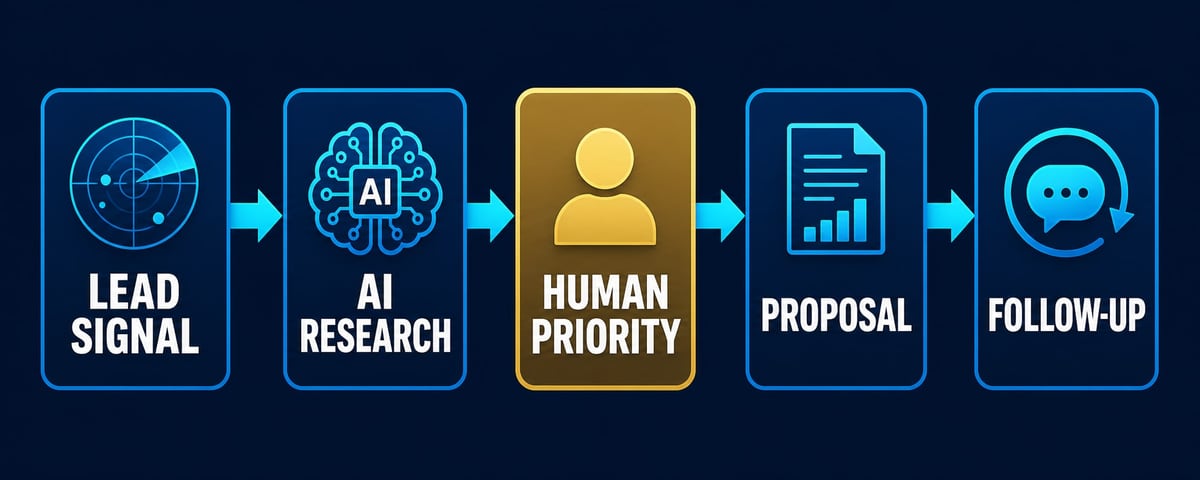
Workflow at a glance
See the orchestration path before exploring the operating detail.
This domain view shows where AI accelerates the work and where accountable human judgment remains in command.
The business problem
Orchestration redesigns the whole operating loop.
Revenue leaks across the gaps between account research, meetings, notes, email, proposal content, pricing, customer relationship management, and follow-up. The seller often becomes the integration layer.
AI orchestration can assemble an account brief, prepare questions, draft a proposal structure, capture commitments, and maintain the follow-up rhythm. The seller owns relationship judgment, claims, pricing, negotiation, and every message sent.
Orchestration corridor
How the work moves from signal to accountable outcome.
Every step has a defined input, intelligence task, action, and handoff. This is what separates an operating system from an isolated prompt.
-
01
Read the terrain
Assemble account, sector, relationship, and trigger-event intelligence.
-
02
Prepare the engagement
Draft hypotheses, questions, relevant proof, and stakeholder map.
-
03
Capture the truth
Convert the conversation into needs, commitments, risks, and decision process.
-
04
Mobilize the response
Coordinate proposal, experts, pricing, evidence, and approvals.
-
05
Maintain momentum
Prepare human-approved follow-up and monitor the next commitment.
Ecosystem command map
The capability lives between systems, not inside one model.
The four quadrants show the assets that must be coordinated. Select any quadrant to emphasize its role in the operating system.
Signals
What enters the system
- Account and market data
- Calls, emails, and meeting notes
- Approved offers, proof, and pricing
Intelligence
What AI organizes
- Stakeholder mapping
- Need and risk extraction
- Content and expert matching
Actions
What the workflow moves
- Create account brief
- Draft proposal structure
- Schedule and track follow-up
Human command
Where authority remains
- Seller owns relationship
- Experts validate claims
- Commercial authority approves terms
Value and control instrument panel
Measure the business result and the integrity of the route.
The bars are not performance claims. They show the measurement sequence: establish the current baseline, agree a pilot threshold, and verify the observed result.
Preparation time
Seller minutes spent before a qualified meeting
Establish baseline → set pilot threshold → verify outcomeFollow-up speed
Time from meeting to approved next-step communication
Establish baseline → set pilot threshold → verify outcomeCommitment integrity
Agreed actions completed on time
Establish baseline → set pilot threshold → verify outcomeCommercial progress
Conversion and cycle time by opportunity stage
Establish baseline → set pilot threshold → verify outcome90-day implementation route
Move from reconnaissance to controlled scale.
Select a phase to inspect its executive decision gate.
Phase 1
Recon
Map one segment's sales motion, source systems, proposal assets, and leakage points.
- Executive owner
- Chief Revenue Officer
- Decision gate
- Problem and baseline confirmed
Phase 2
Pilot
Support ten live opportunities with account briefs and follow-up discipline.
- Executive owner
- Chief Revenue Officer
- Decision gate
- Value and control thresholds met
Phase 3
Scale
Integrate proposal and relationship workflows after seller adoption is demonstrated.
- Executive owner
- Chief Revenue Officer
- Decision gate
- Operating owner accepts scale
Source and governance discipline
Evidence first. Claims qualified. Accountability designed in.
This operating play is an independent synthesis by Dr. Alejandro Canonero, DBA. It translates a documented implementation into a vendor-neutral business design and applies the War of the Ecosystems perspective. It does not imply endorsement by the source organization.
Executive working session
Apply this pattern to your growth workflow.
A focused diagnosis will map the current work, quantify the opportunity, define human command, and shape the first controlled pilot.