Use case 02 · Risk
Insurance claims and fraud triage
Organize claim evidence, detect suspicious patterns, and prepare explainable investigator briefs without delegating claim decisions.
Shift Technology
Published by Microsoft
Shift Technology helps hundreds of insurers fight claims fraud using Azure OpenAI Service
The case describes artificial intelligence used to sort and classify policy, claim, and supporting documents for faster fraud investigation.
- The company reports reducing weeks of sorting, classification, and decision support to days.
- The platform supports insurers across the policy life cycle.
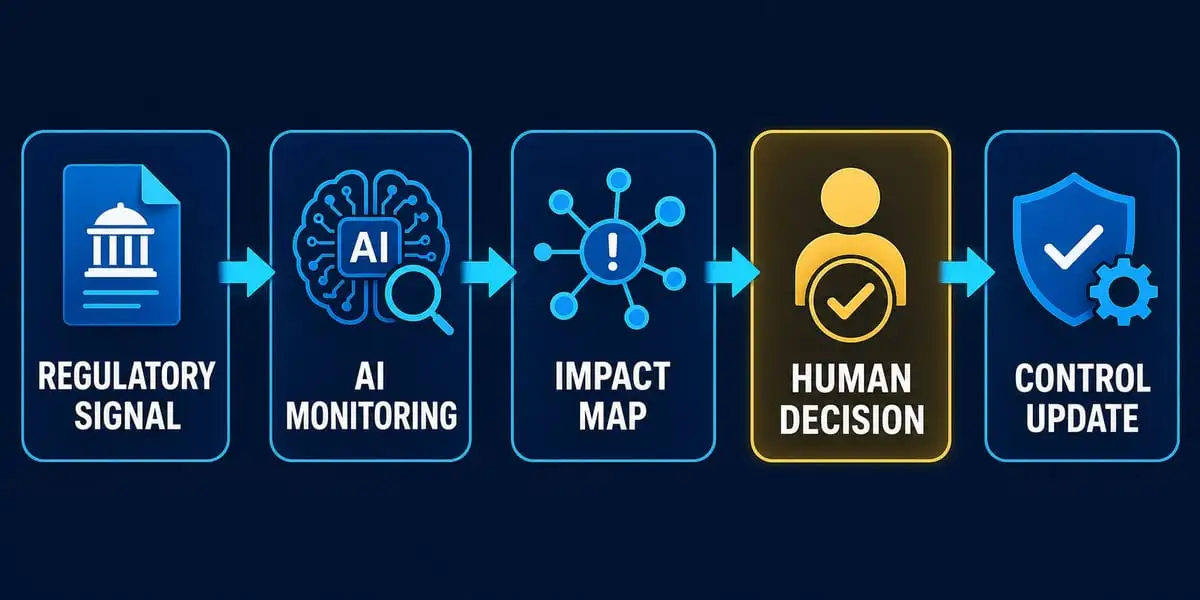
Workflow at a glance
See the orchestration path before exploring the operating detail.
This domain view shows where AI accelerates the work and where accountable human judgment remains in command.
The business problem
Orchestration redesigns the whole operating loop.
Claims teams must connect policies, forms, images, correspondence, prior activity, external signals, and fraud indicators under time pressure. The burden is not one prediction; it is the disciplined assembly of evidence.
AI orchestration can classify the incoming material, surface inconsistencies, build a chronology, and recommend the next investigative step. The claim decision and any adverse action remain with authorized professionals.
Orchestration corridor
How the work moves from signal to accountable outcome.
Every step has a defined input, intelligence task, action, and handoff. This is what separates an operating system from an isolated prompt.
-
01
Ingest the claim
Register forms, images, adjuster notes, messages, and policy context.
-
02
Build the chronology
Normalize dates, parties, events, locations, and prior activity.
-
03
Surface anomalies
Compare evidence, detect contradictions, and rank investigative signals.
-
04
Brief the investigator
Present traceable evidence, uncertainty, and recommended next checks.
-
05
Record the decision
Capture human rationale, disposition, and feedback for monitoring.
Ecosystem command map
The capability lives between systems, not inside one model.
The four quadrants show the assets that must be coordinated. Select any quadrant to emphasize its role in the operating system.
Signals
What enters the system
- Claim documents and images
- Policy and payment history
- External and partner data
Intelligence
What AI organizes
- Entity matching
- Chronology construction
- Anomaly and network analysis
Actions
What the workflow moves
- Request evidence
- Prioritize investigation
- Prepare case brief
Human command
Where authority remains
- Investigator validates evidence
- Claims authority decides
- Compliance monitors adverse outcomes
Value and control instrument panel
Measure the business result and the integrity of the route.
The bars are not performance claims. They show the measurement sequence: establish the current baseline, agree a pilot threshold, and verify the observed result.
Triage cycle time
Time from intake to investigator-ready file
Establish baseline → set pilot threshold → verify outcomeEvidence completeness
Required facts present before review
Establish baseline → set pilot threshold → verify outcomeInvestigator yield
High-priority cases confirmed after review
Establish baseline → set pilot threshold → verify outcomeDecision consistency
Variance and overturn rate across comparable cases
Establish baseline → set pilot threshold → verify outcome90-day implementation route
Move from reconnaissance to controlled scale.
Select a phase to inspect its executive decision gate.
Phase 1
Recon
Study one claim type, evidence map, fraud typology, and current investigator queue.
- Executive owner
- Chief Claims Officer
- Decision gate
- Problem and baseline confirmed
Phase 2
Pilot
Generate evidence chronologies and briefs without changing claim outcomes.
- Executive owner
- Chief Claims Officer
- Decision gate
- Value and control thresholds met
Phase 3
Scale
Add prioritization only after legal, compliance, and fairness review.
- Executive owner
- Chief Claims Officer
- Decision gate
- Operating owner accepts scale
Source and governance discipline
Evidence first. Claims qualified. Accountability designed in.
This operating play is an independent synthesis by Dr. Alejandro Canonero, DBA. It translates a documented implementation into a vendor-neutral business design and applies the War of the Ecosystems perspective. It does not imply endorsement by the source organization.
Executive working session
Apply this pattern to your risk workflow.
A focused diagnosis will map the current work, quantify the opportunity, define human command, and shape the first controlled pilot.