Use case 12 · People
Recruitment and candidate matching
Structure job requirements, compare evidence, and coordinate candidate journeys without automating the hiring decision.
The Adecco Group
Published by Microsoft
The Adecco Group's AI skilling strategy fuels productivity with Microsoft Copilot
The case describes artificial intelligence embedded in recruitment operations, including resume screening and candidate matching, alongside responsible-use training.
- The Adecco Group reports a 63% increase in recruiter productivity.
- The organization also reports 35,000 employees completed responsible artificial intelligence training.
Workflow at a glance
See the orchestration path before exploring the operating detail.
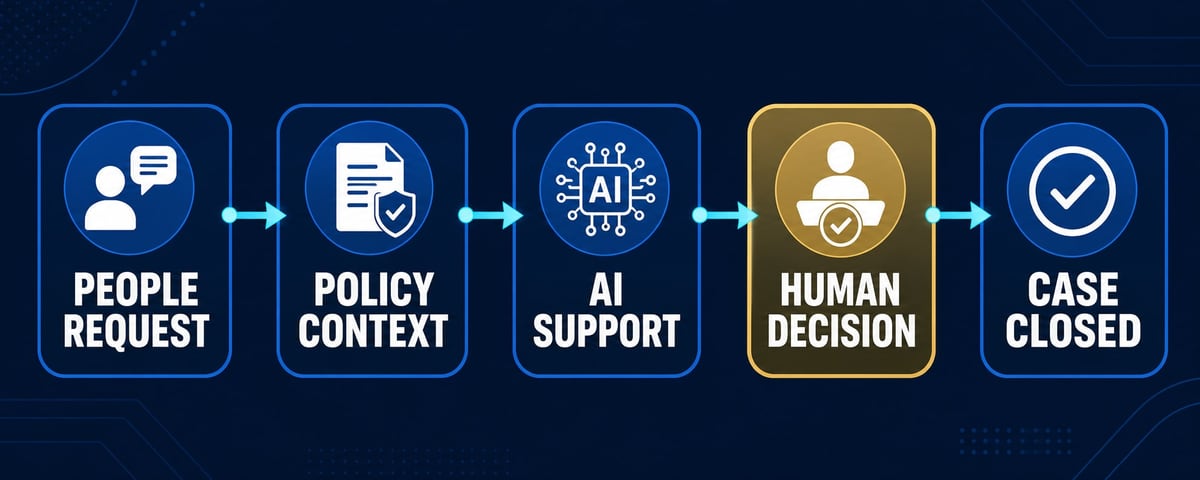
This domain view shows where AI accelerates the work and where accountable human judgment remains in command.
The business problem
Orchestration redesigns the whole operating loop.
Recruitment spans role design, sourcing, application intake, evidence comparison, scheduling, interviews, references, offers, and candidate communication. Unstructured volume can crowd out the human conversations that determine fit.
AI orchestration can improve job descriptions, summarize application evidence against explicit criteria, coordinate scheduling, and prepare interview packs. People make shortlist, interview, selection, compensation, and rejection decisions.
Orchestration corridor
How the work moves from signal to accountable outcome.
Every step has a defined input, intelligence task, action, and handoff. This is what separates an operating system from an isolated prompt.
-
01
Define the role
Translate business outcomes into skills, evidence, constraints, and fair criteria.
-
02
Structure applications
Extract relevant experience without inferring protected characteristics.
-
03
Compare transparently
Show evidence against criteria, uncertainty, and missing information.
-
04
Support interviews
Prepare structured questions, notes, and consistent evaluation records.
-
05
Coordinate the journey
Maintain timely communication, scheduling, and approved decisions.
Ecosystem command map
The capability lives between systems, not inside one model.
The four quadrants show the assets that must be coordinated. Select any quadrant to emphasize its role in the operating system.
Signals
What enters the system
- Role outcomes and criteria
- Candidate-provided evidence
- Interview and assessment records
Intelligence
What AI organizes
- Evidence extraction
- Criteria comparison
- Scheduling and communication support
Actions
What the workflow moves
- Prepare candidate brief
- Draft interview guide
- Coordinate next steps
Human command
Where authority remains
- Recruiter owns process
- Hiring manager decides
- People and legal teams monitor fairness
Value and control instrument panel
Measure the business result and the integrity of the route.
The bars are not performance claims. They show the measurement sequence: establish the current baseline, agree a pilot threshold, and verify the observed result.
Recruiter capacity
Qualified candidates managed per recruiter
Establish baseline → set pilot threshold → verify outcomeTime to decision
Elapsed days by hiring stage
Establish baseline → set pilot threshold → verify outcomeCandidate experience
Response timeliness, satisfaction, and withdrawal
Establish baseline → set pilot threshold → verify outcomeFairness indicators
Selection and progression patterns across monitored groups
Establish baseline → set pilot threshold → verify outcome90-day implementation route
Move from reconnaissance to controlled scale.
Select a phase to inspect its executive decision gate.
Phase 1
Recon
Choose one role family with explicit skills and sufficient historical process data.
- Executive owner
- Head of Talent Acquisition
- Decision gate
- Problem and baseline confirmed
Phase 2
Pilot
Use summaries and scheduling support while preserving the existing shortlist process.
- Executive owner
- Head of Talent Acquisition
- Decision gate
- Value and control thresholds met
Phase 3
Scale
Add comparison views only after legal and fairness validation.
- Executive owner
- Head of Talent Acquisition
- Decision gate
- Operating owner accepts scale
Source and governance discipline
Evidence first. Claims qualified. Accountability designed in.
This operating play is an independent synthesis by Dr. Alejandro Canonero, DBA. It translates a documented implementation into a vendor-neutral business design and applies the War of the Ecosystems perspective. It does not imply endorsement by the source organization.
Executive working session
Apply this pattern to your people workflow.
A focused diagnosis will map the current work, quantify the opportunity, define human command, and shape the first controlled pilot.