Use case 04 · Finance
Financial close and reconciliation
Coordinate reconciliations, journal support, variance analysis, and review evidence across the monthly close.
Stacks
Published by Google Cloud
Stacks: Accelerating and enhancing the reliability of financial closing with Google Cloud AI
The case describes an accounting automation platform coordinating bank reconciliation, journal entries, variance analysis, and report generation.
- The platform is designed to shorten closing time and standardize workflows across differing enterprise systems.
- The company reports faster customer onboarding through flexible document and data interpretation.
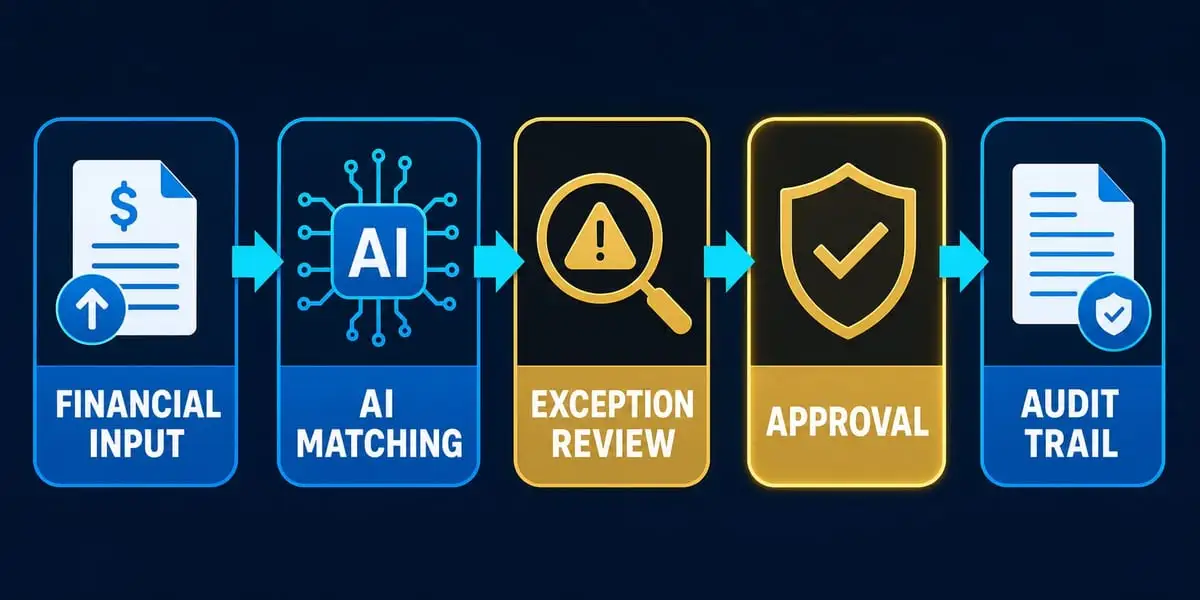
Workflow at a glance
See the orchestration path before exploring the operating detail.
This domain view shows where AI accelerates the work and where accountable human judgment remains in command.
The business problem
Orchestration redesigns the whole operating loop.
The monthly close is a coordinated campaign across transactions, ledgers, bank statements, enterprise systems, spreadsheets, explanations, and approvals. Delay accumulates at every unclear handoff.
AI agents can prepare reconciliations, draft variance explanations, assemble support, and watch dependencies. Finance professionals still own materiality, accounting judgment, journal approval, and the final representation of results.
Orchestration corridor
How the work moves from signal to accountable outcome.
Every step has a defined input, intelligence task, action, and handoff. This is what separates an operating system from an isolated prompt.
-
01
Open the close
Launch the calendar, dependencies, owners, thresholds, and evidence requirements.
-
02
Reconcile
Match balances and transactions using prior rules and current-period context.
-
03
Investigate variance
Surface movements, likely drivers, missing support, and unusual items.
-
04
Review and approve
Route material judgments and journals to authorized finance owners.
-
05
Publish and retain
Produce reporting support and preserve the complete close record.
Ecosystem command map
The capability lives between systems, not inside one model.
The four quadrants show the assets that must be coordinated. Select any quadrant to emphasize its role in the operating system.
Signals
What enters the system
- General ledger and subledgers
- Bank and operational data
- Close calendar and prior evidence
Intelligence
What AI organizes
- Matching and exception logic
- Variance explanation
- Dependency monitoring
Actions
What the workflow moves
- Prepare reconciliation
- Draft journal support
- Escalate material variance
Human command
Where authority remains
- Account owner certifies
- Controller approves judgments
- Audit tests evidence
Value and control instrument panel
Measure the business result and the integrity of the route.
The bars are not performance claims. They show the measurement sequence: establish the current baseline, agree a pilot threshold, and verify the observed result.
Days to close
Elapsed business days to approved reporting
Establish baseline → set pilot threshold → verify outcomeReconciliation automation
Share prepared without manual matching
Establish baseline → set pilot threshold → verify outcomeReview rework
Items returned for missing or weak support
Establish baseline → set pilot threshold → verify outcomeLate adjustments
Material corrections after initial close
Establish baseline → set pilot threshold → verify outcome90-day implementation route
Move from reconnaissance to controlled scale.
Select a phase to inspect its executive decision gate.
Phase 1
Recon
Map one entity or account family with repeatable reconciliations and stable source data.
- Executive owner
- Controller
- Decision gate
- Problem and baseline confirmed
Phase 2
Pilot
Prepare reconciliations and variance briefs alongside the current close.
- Executive owner
- Controller
- Decision gate
- Value and control thresholds met
Phase 3
Scale
Expand after two clean cycles and documented controller acceptance.
- Executive owner
- Controller
- Decision gate
- Operating owner accepts scale
Source and governance discipline
Evidence first. Claims qualified. Accountability designed in.
This operating play is an independent synthesis by Dr. Alejandro Canonero, DBA. It translates a documented implementation into a vendor-neutral business design and applies the War of the Ecosystems perspective. It does not imply endorsement by the source organization.
Executive working session
Apply this pattern to your finance workflow.
A focused diagnosis will map the current work, quantify the opportunity, define human command, and shape the first controlled pilot.