Use case 72 · Growth
Everyday brand conversation
Connect brand knowledge, creative generation, and review into a scalable conversation workflow.
Everyday
Published by Google Cloud
Everyday: Reinventing the conversation between brands and their clients with Google Cloud's Generative AI
The published Google Cloud customer story documents Everyday's use of connected data, AI, and workflow design in this domain.
- The customer story documents three generative AI use cases for branded text, visual creation, and brand alignment.
- The example is treated as evidence of a design pattern, not a promise that every deployment will reproduce the same result.
Workflow at a glance
See the orchestration path before exploring the operating detail.
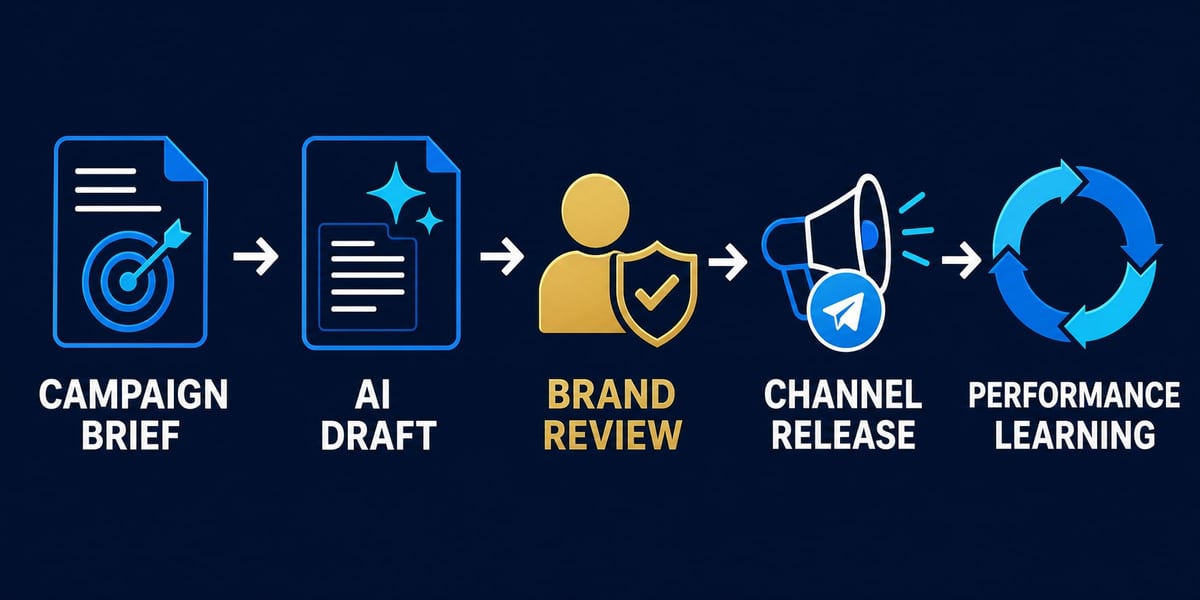
This domain view shows where AI accelerates the work and where accountable human judgment remains in command.
The business problem
Orchestration redesigns the whole operating loop.
Brands need to create relevant content across channels without losing consistency, ethics, or client context.
Everyday is a public proof point for the pattern. The transferable lesson is the operating design: a conversational content workflow can combine generation and brand controls while making the human release decision explicit.
Orchestration corridor
How the work moves from signal to accountable outcome.
Every step has a defined input, intelligence task, action, and handoff. This is what separates an operating system from an isolated prompt.
-
01
Frame the demand
Define the business signal, Client questions, briefs, brand signals, and channel needs, and the outcome that matters.
-
02
Assemble context
Connect approved records, knowledge, and brand knowledge, approved content, and audience requirements before the model acts.
-
03
Coordinate the work
Use AI to draft, personalize, adapt, and check brand alignment, then route uncertainty to the accountable owner.
-
04
Execute with limits
Move the permitted task through existing systems while preserving brand, ethics, claims, and editor approval.
-
05
Measure the result
Track approved conversation cycle time, quality, exceptions, and the effect on the wider ecosystem.
Ecosystem command map
The capability lives between systems, not inside one model.
The four quadrants show the assets that must be coordinated. Select any quadrant to emphasize its role in the operating system.
Signals
What enters the system
- Client questions, briefs, brand signals, and channel needs
- brand knowledge, approved content, and audience requirements
- Outcome, urgency, and exception signals
Intelligence
What AI organizes
- draft, personalize, adapt, and check brand alignment
- Evidence retrieval and prioritization
- Pattern, risk, and confidence analysis
Actions
What the workflow moves
- Prepare the next best action
- Route, draft, or update the authorized system
- Escalate the consequential exception
Human command
Where authority remains
- Business owner sets the objective
- Subject-matter expert validates the decision
- Risk and data owners monitor the boundary
Value and control instrument panel
Measure the business result and the integrity of the route.
The bars are not performance claims. They show the measurement sequence: establish the current baseline, agree a pilot threshold, and verify the observed result.
approved conversation cycle time
Baseline the current approved conversation cycle time and compare the assisted path with the existing process.
Establish baseline → set pilot threshold → verify outcomeQuality at handoff
Measure whether the human owner receives complete, relevant, and traceable context.
Establish baseline → set pilot threshold → verify outcomeException rate
Track uncertainty, rework, escalation, and failure by workflow segment.
Establish baseline → set pilot threshold → verify outcomeBusiness outcome
Connect the workflow change to more relevant brand conversations with governed creativity, not just model activity.
Establish baseline → set pilot threshold → verify outcome90-day implementation route
Move from reconnaissance to controlled scale.
Select a phase to inspect its executive decision gate.
Phase 1
Recon
Map the current everyday brand conversation workflow, owners, evidence, systems, and failure modes.
- Executive owner
- Chief Operating Officer
- Decision gate
- Problem and baseline confirmed
Phase 2
Pilot
Run one bounded workflow with the current process as a comparison and make approved conversation cycle time visible.
- Executive owner
- Chief Operating Officer
- Decision gate
- Value and control thresholds met
Phase 3
Scale
Expand only after quality, control, adoption, and ecosystem effects are accepted by the operating owner.
- Executive owner
- Chief Operating Officer
- Decision gate
- Operating owner accepts scale
Source and governance discipline
Evidence first. Claims qualified. Accountability designed in.
This operating play is an independent synthesis by Dr. Alejandro Canonero, DBA. It translates a documented implementation into a vendor-neutral business design and applies the War of the Ecosystems perspective. It does not imply endorsement by the source organization.
Executive working session
Apply this pattern to your growth workflow.
A focused diagnosis will map the current work, quantify the opportunity, define human command, and shape the first controlled pilot.