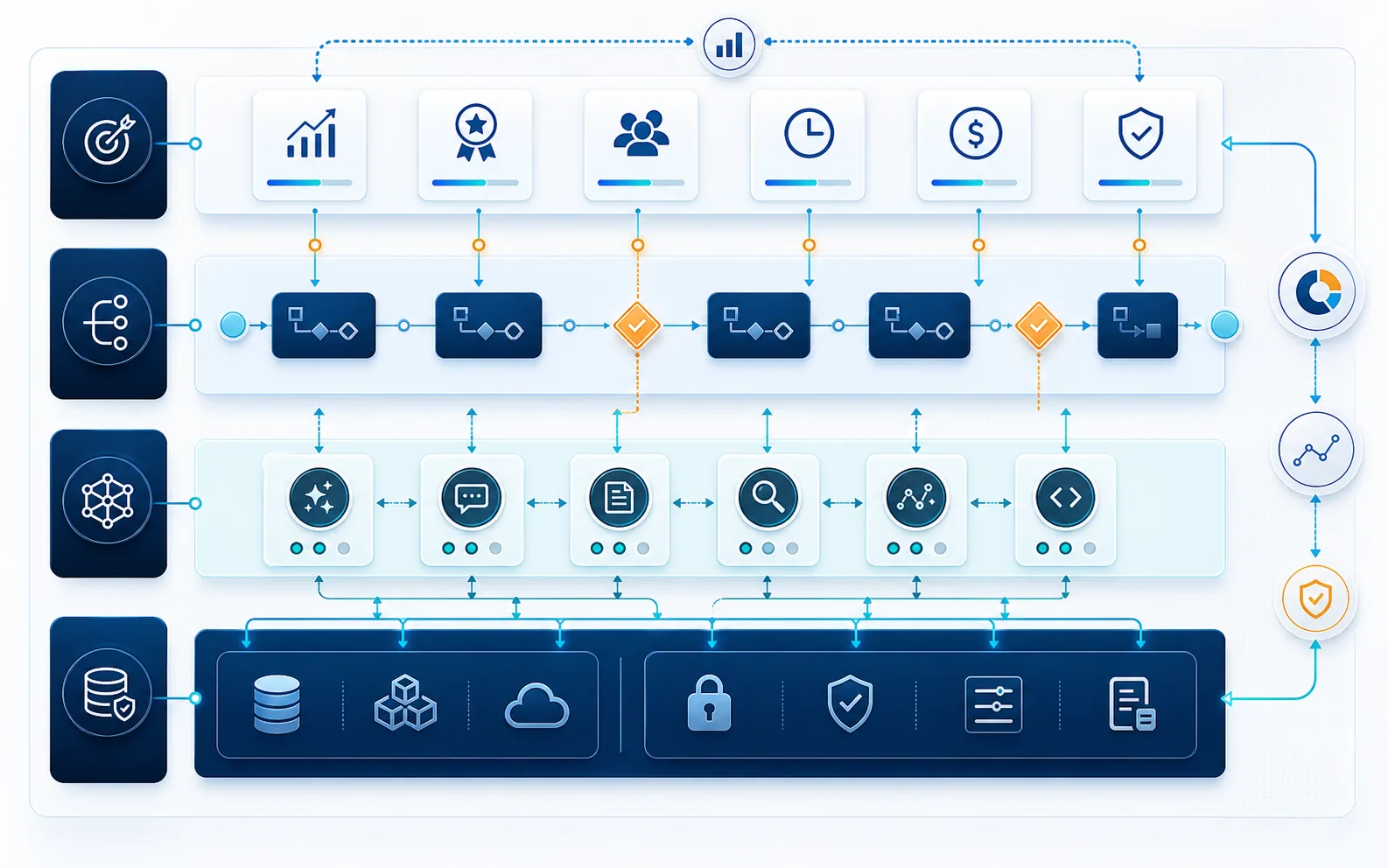
Working definition: AI workflow orchestration is the design and coordination of artificial intelligence, people, data, applications, policies, and handoffs around a repeatable business process. The goal is not more AI activity. The goal is a better operating result.
Why orchestration matters now
Most organizations already have access to capable models, copilots, automation tools, and software integrations. Access is no longer the primary constraint. The harder problem is deciding where artificial intelligence belongs in the work, what information it may use, which decisions remain human, how exceptions move, and which result proves the investment was worthwhile.
Without orchestration, AI use stays fragmented. Employees open chat windows, copy sensitive context between systems, rewrite prompts, check inconsistent outputs, and manually move results into email, documents, customer relationship management systems, or finance tools. The model may be impressive while the operating process remains slow.
Orchestration turns those isolated moments into a managed workflow. It establishes the trigger, inputs, task sequence, ownership, decision rights, review gates, exception path, service level, and business metric. Artificial intelligence then becomes one capability inside a designed system.
Automation moves a task. Orchestration improves the system of work.
A task can be automated while the wider process still leaks time, quality, revenue, and accountability. Orchestration examines the complete route from demand to outcome and decides where people, agents, software, and controls should interact.
The seven layers of an AI workflow operating model
Outcome
Define the operating result in measurable terms: cycle time, cost per case, conversion, response speed, quality, risk, or capacity.
Workflow
Map the trigger, inputs, steps, decisions, owners, handoffs, systems, exceptions, and completion criteria.
People
Assign accountability, subject-matter review, approval authority, escalation ownership, and adoption responsibilities.
AI roles
Give each model or agent a narrow job such as classification, extraction, drafting, comparison, research, routing, or monitoring.
Data and applications
Connect approved knowledge and systems through controlled access, traceable sources, and explicit write permissions.
Controls
Define privacy rules, validation, confidence thresholds, review gates, audit trails, fallback behavior, and exception handling.
Learning
Measure outcomes, review failures, improve instructions and knowledge, and version the workflow as evidence accumulates.
Where to start
The best first workflow is rarely the most ambitious one. It is repeated often enough to matter, painful enough to motivate change, structured enough to map, measurable enough to prove value, and reviewable enough to control risk.
Useful first candidates include lead follow-up, proposal preparation, recurring reporting, document intake, customer support triage, meeting-to-action workflows, knowledge retrieval, compliance evidence gathering, and professional-service document production. The workflow opportunity matrix and opportunity checklist help compare these candidates without buying software first.
How to calculate return on investment
A credible business case begins with the current workflow. Measure annual case volume, human minutes per case, loaded labor cost, delay, rework, error exposure, missed follow-up, and the value of additional capacity. Then estimate the portion realistically affected by the redesigned process.
Use conservative assumptions. Count implementation effort, integration, licenses, review time, change support, and maintenance. Separate hard savings from capacity released and revenue opportunity. A useful pilot should produce a before-and-after comparison within one operating cycle, not a theoretical benefit that cannot be observed.
Current operating cost
Volume multiplied by handling time and loaded cost, plus measurable rework, delay, and quality loss.
Expected improvement
Time removed, cycle time shortened, errors prevented, follow-up recovered, or throughput added.
Total cost to operate
Design, integration, software, governance, training, human review, monitoring, and maintenance.
Measured pilot result
Observed business performance over a defined period compared with the documented baseline.
Governance without paralysis
Governance should be proportionate to the consequence of an error. A low-risk internal summary may need source links and a human check. A customer communication may require approved templates, policy checks, and named approval. A financial, legal, health, employment, or regulatory decision demands much stronger controls and may not be appropriate for autonomous execution.
Every production workflow should answer six questions: what data may be used, what the AI may do, what it may never do, who reviews the result, how exceptions escalate, and where the evidence is recorded. Clear boundaries increase speed because teams do not need to renegotiate safety on every case.
A practical 90-day implementation sequence
Diagnose
Choose one workflow, document the baseline, identify the business owner, and define the decision and data boundaries.
Design
Map the target workflow, assign AI and human roles, define controls, and agree on success measures.
Pilot
Run a controlled sample with visible review, exception capture, security checks, and measurement.
Prove and decide
Compare results with the baseline, fix failure modes, document the operating model, and decide whether to scale.
Common failure modes
- Starting with a tool: the organization buys capability before agreeing on the workflow and outcome.
- Automating an unstable process: unclear ownership and exceptions become faster confusion.
- Giving an agent a broad mission: the task lacks boundaries, approved knowledge, and measurable completion criteria.
- Hiding human review: teams underestimate the time and judgment needed to make outputs dependable.
- Ignoring adoption: a technically sound workflow fails because incentives, roles, and daily habits do not change.
- Measuring usage instead of value: prompt volume and licenses replace evidence of cost, speed, quality, or growth.
Frequently asked questions
Is AI workflow orchestration the same as robotic process automation?
No. Robotic process automation executes deterministic steps. AI orchestration can combine deterministic automation with model reasoning, retrieval, agents, people, business rules, and feedback. The two can work together inside the same process.
Do we need an enterprise orchestration platform?
Not necessarily. A first workflow may use existing applications, approved model access, simple integrations, and disciplined human review. Platform decisions should follow the operating requirements, not precede them.
What should remain human?
Keep human accountability where judgment, empathy, material risk, legal responsibility, strategic choice, or exception handling matters. The correct boundary depends on the consequence of an error and the quality of available evidence.
How many workflows should a first pilot include?
Usually one. A narrow pilot makes the baseline, controls, adoption effort, and measured result visible. It also creates reusable operating knowledge before complexity expands.
Bring one workflow where time, quality, cost, or follow-up is already leaking.
The diagnosis maps the current work, identifies the smallest credible intervention, and defines the evidence needed to justify a controlled pilot.
Request an AI workflow diagnosis Assess workflow readiness